What Is a Business Moat — and Why Warren Buffett Won’t Invest Without One
Every startup founder worries about competition. Someone will copy the idea. A bigger company will build the same feature. A well-funded rival will undercut the price.
Warren Buffett has a different way of thinking about this problem. Instead of asking “how do we beat the competition,” he asks one question first: does this business have a moat?
Understanding what a business moat is — and whether your startup has one — is one of the most important strategic questions any founder can ask.
What a business moat actually is
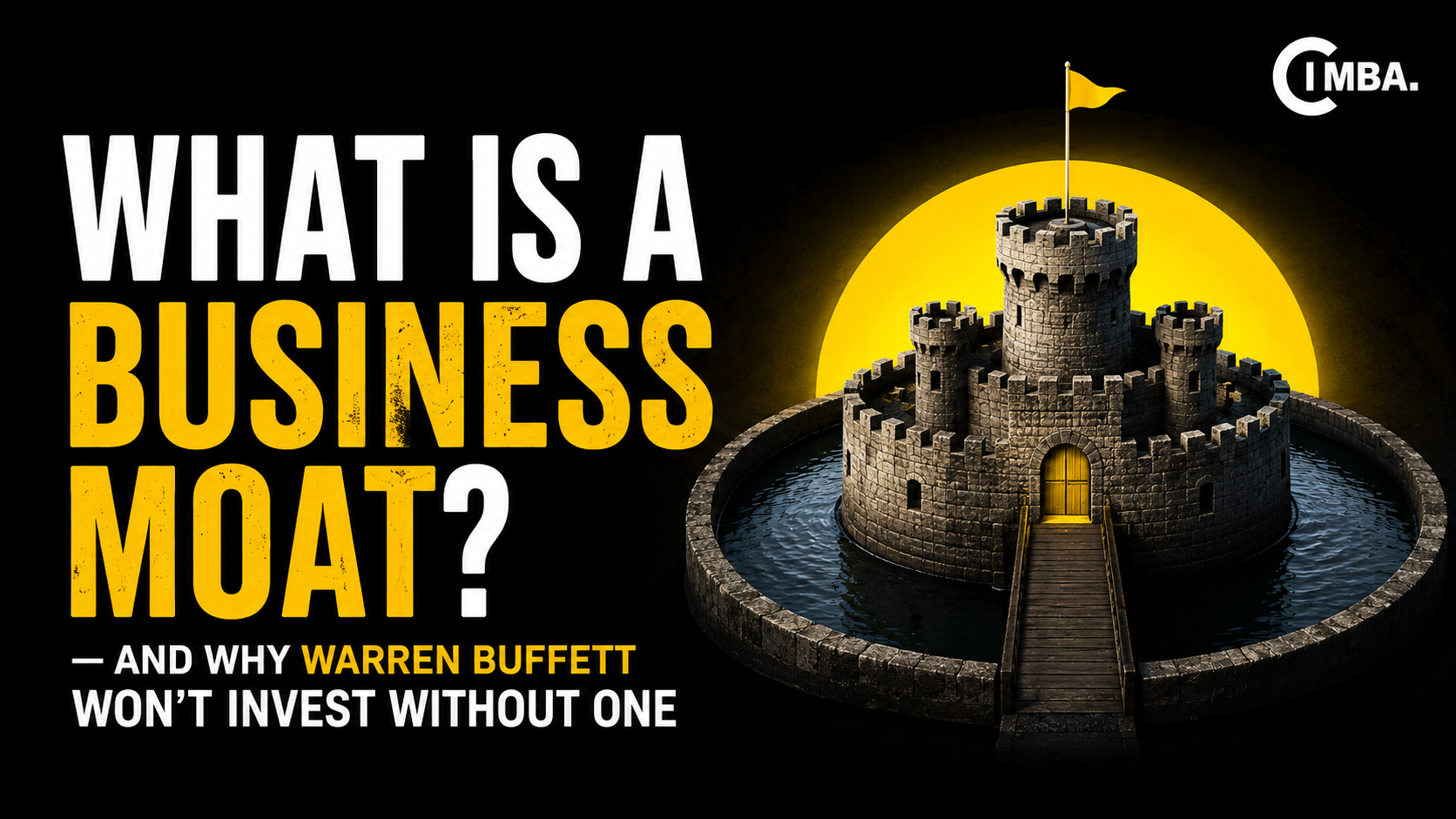
The term comes from medieval castle architecture. A moat was a deep trench filled with water surrounding a castle, making it extremely difficult for attackers to reach the walls. The deeper and wider the moat, the safer the castle.
Warren Buffett borrowed this metaphor to describe businesses with durable competitive advantages — structural features that make it difficult for competitors to take market share, regardless of how hard they try.
A moat is not a better product. It is not a lower price. It is not a smarter team. All of those can be copied or outspent. A moat is something structural — baked into how the business works — that gets stronger over time rather than weaker.
This is why Buffett famously said he looks for businesses with wide, sustainable moats. Not the best product today. The hardest business to attack tomorrow.
As we explored when looking at what a business model actually is, the most valuable businesses are not just those that create value — they are those that can protect the value they create. A moat is the mechanism of that protection.
The five types of business moats
There is no single way to build a moat. The strongest businesses often have more than one. Here are the five main types — each illustrated with a company you already know.
Cost moat
A cost moat exists when a business can produce or deliver its product at a cost that competitors simply cannot match — not because of temporary efficiency, but because of structural advantages like scale, infrastructure, or unique access to resources.
Jio is the clearest Indian example. When Reliance launched Jio in 2016, it had already spent over ₹1.5 lakh crore building 4G infrastructure across India before a single customer signed up. No competitor could replicate that investment. The result was data prices so low that every existing telecom was forced to either merge, collapse, or bleed cash trying to compete. Jio’s moat was not a better app — it was an infrastructure investment so large it made competition structurally impossible for anyone without equivalent capital.
Network effect moat
A network effect moat exists when a product becomes more valuable as more people use it. The moat grows automatically with scale — and becomes nearly impossible to dislodge because switching away means losing the network.
Zomato is a marketplace built entirely on network effects. More restaurants on the platform attract more hungry customers. More customers attract more restaurants. Each side of the marketplace makes the other side more valuable. A new competitor cannot simply build a better app — it needs to simultaneously convince thousands of restaurants and millions of users to switch, which is extraordinarily difficult when both groups are already getting value from the existing network.
WhatsApp is the global example. Its only moat is that everyone you know is already on it. A technically superior messaging app has been built many times. None have displaced WhatsApp in markets where it is dominant, because the network itself is the product.
Switching cost moat
A switching cost moat exists when changing to a competitor is so painful, expensive, or time-consuming that customers stay even if they are not entirely satisfied.
Google’s suite of products is built on switching costs. A company that has used Google Workspace for five years has years of emails, documents, and institutional knowledge stored in Google’s ecosystem. Moving to Microsoft or any alternative requires migrating that data, retraining staff, and rebuilding workflows. The switching cost is real and significant — which is why enterprise customers rarely leave regardless of competing offers.
In the Indian startup context, Zoho has built a similar moat. Once a business integrates Zoho CRM, Zoho Books, and Zoho Mail, the cost of switching is not just financial — it is operational. That stickiness is the moat.
Brand moat
A brand moat exists when a company’s name or identity creates such strong consumer trust, preference, or emotional association that competitors cannot easily replicate it regardless of product quality.
Fevicol is one of the strongest brand moats in Indian business history. It is so dominant that “Fevicol” has become the generic word for adhesive in India — the way “Xerox” became synonymous with photocopying. A competitor making an identical product at a lower price still loses because the contractor, the carpenter, and the homeowner all ask for Fevicol by name. The brand itself is the barrier.
Asian Paints built the same kind of moat in the Indian paint industry — decades of trust and distribution relationships that no amount of advertising spend by a new entrant can replicate overnight.
Data and intangibles moat
A data moat exists when a business accumulates proprietary data or knowledge that competitors cannot access — and that data directly improves the product or enables decisions that others cannot make.
As we explored in the CRED breakdown, CRED’s real asset is not its app — it is its database of India’s highest-credit-score consumers and their detailed spending behaviour. No competitor can buy or replicate that dataset. The longer CRED operates, the deeper and more valuable that data becomes. That is a data moat compounding over time.
Google’s search dominance works the same way. Every search query trains Google’s algorithm. Billions of daily searches make the algorithm better. A better algorithm attracts more searches. No competitor starting today has access to twenty years of search behaviour data — which is why even technically capable competitors like Bing cannot close the gap.
Why features are not a moat
The most important thing to understand about moats is what they are not.
A better feature is not a moat. Features can be copied, usually within months. Instagram copied Snapchat Stories and destroyed Snapchat’s growth overnight. Every food delivery app copied every other food delivery app’s interface within a quarter. If your competitive advantage is a feature, you do not have a moat — you have a head start.
A lower price is not a moat unless it is structural. Temporary discounting is not a cost moat. A cost moat means you can permanently produce at lower cost because of scale, infrastructure, or access — not because you are choosing to sacrifice margin.
A great team is not a moat. Teams change. The structural advantage has to outlast any individual.
This is why product market fit, while essential, is not a moat either. PMF confirms the market wants what you built. A moat ensures competitors cannot easily take that market from you once you have found it.
How to know if your startup has a moat
Most early stage startups do not have a moat yet — and that is normal. Moats are built over time, not launched with the product.
The right question for an early stage founder is not “do we have a moat” but “are we building toward one?”
Ask yourself three questions. First — if a well-funded competitor copied everything we do today, how long would it take them to match us? If the honest answer is six months or less, there is no moat yet.
Second — does our product get harder to replace the longer a customer uses it? If the answer is yes, you are building switching costs. If the answer is no, you are vulnerable.
Third — does scale make our economics better or just bigger? If growing means your cost per unit falls, or your data gets more valuable, or your network becomes more useful — that is a moat forming. If growing just means doing the same thing at greater volume with similar margins, that is not a moat.
The businesses that compound in value over decades are almost always the ones where the answer to all three questions points toward a moat widening with time — not one that needs to be defended harder every year.
Understanding business means understanding not just how value is created — but how it is protected.
Startup takeaway:
“A moat is not what makes you better today. It is what makes you harder to beat tomorrow.”
Ready to test your understanding? Download the free Semester 1 Worksheet and apply every concept to a startup you know.