What Is a Business Model — and Why Most People Get It Wrong
Every startup founder has used the phrase “business model” at least a hundred times. Very few can explain what it actually means.
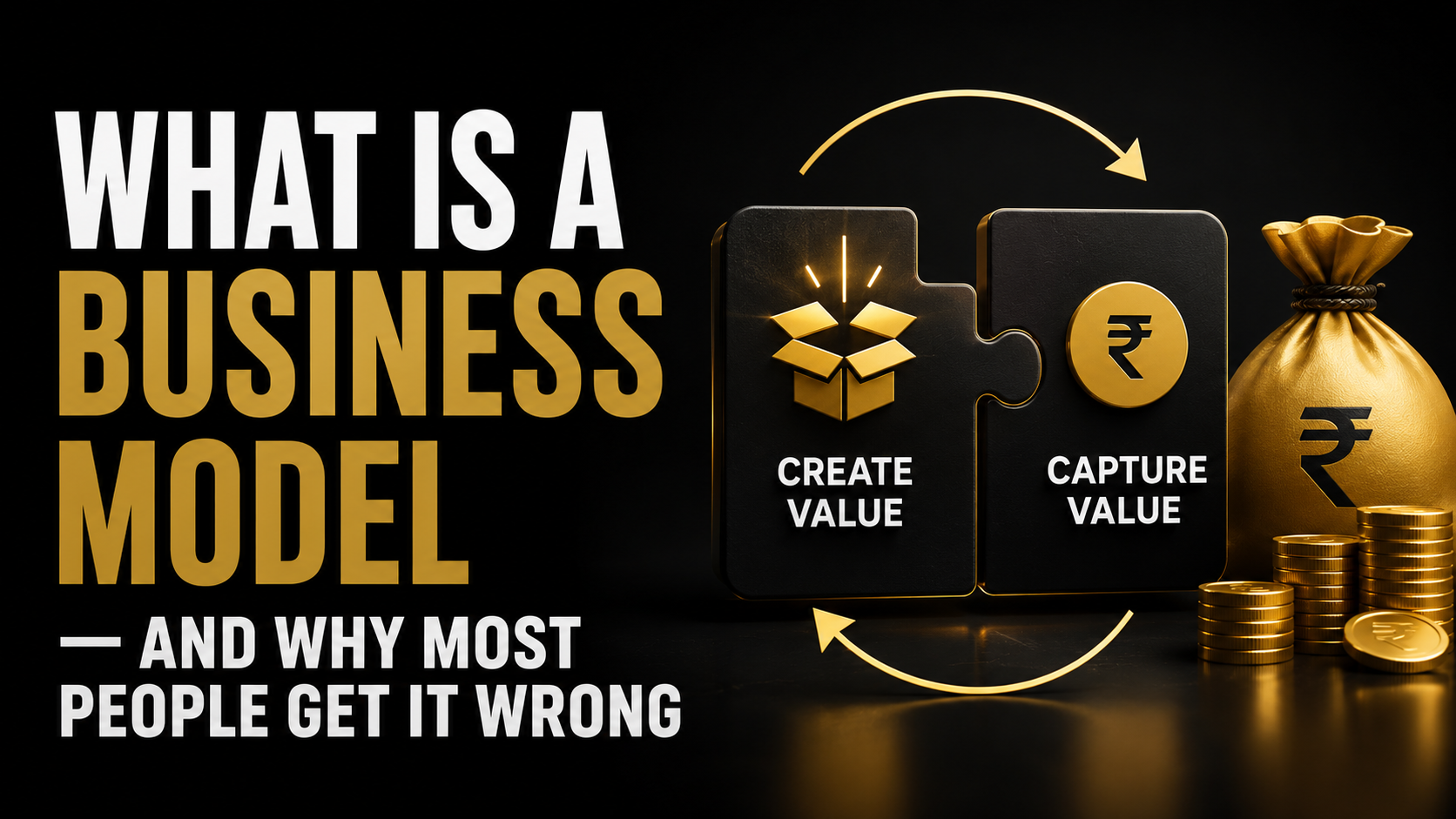
Most people think a business model is a plan — a document, a pitch deck, a strategy. It isn’t. A business model is simpler and more fundamental than that. It is the logic of how a business creates value for someone and captures some of that value back as revenue.
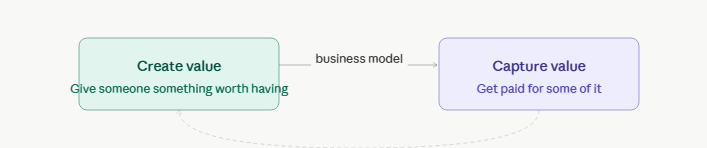
That’s it. Two things: create value, capture value.
The reason this matters is that two businesses can sell the exact same product and have completely different business models — and one can be worth ten times more than the other because of it.
Creating value versus capturing value
Creating value means giving someone something worth having. A restaurant creates value by feeding you. Google creates value by answering your questions. Zomato creates value by delivering food to your door without you having to call fifteen different restaurants.
But creating value alone doesn’t make a business. Thousands of useful things exist in the world that make no money. The second half — capturing value — is where the business model lives.
Google creates value for you every time you search. But Google doesn’t charge you a rupee for that. Instead it captures value from advertisers who pay to appear next to your search results. The product is free. The business model is selling your attention.
This is why understanding business models changes how you see every company around you. The customer and the paying customer are often not the same person.
The same product, completely different models
Consider music. Spotify and Apple Music both let you listen to the same songs. But their business models are different in a meaningful way.
Apple Music is pure subscription — you pay every month, you get access, that’s the entire exchange. Spotify runs a freemium model — most users pay nothing, a smaller percentage pay for premium, and the free users generate advertising revenue while also serving as a constant funnel toward paid conversion.
Same product. Different logic for how money flows.
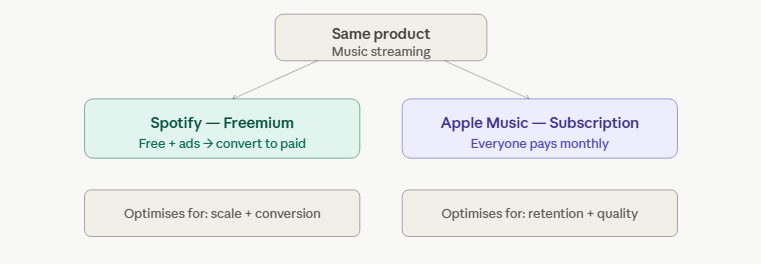
Neither is better by default. Each model has different implications for growth, profitability, and what the company optimises for. Spotify needs massive scale to make the free tier worthwhile. Apple Music needs fewer, higher-quality paying customers.
Why Zomato’s business model is more complex than it looks
Most people think Zomato makes money by charging you a delivery fee. That’s true but it’s a small part of the picture.
Zomato runs what is called a marketplace model. It connects restaurants with hungry customers and takes a commission from restaurants on every order. They charge restaurants for premium listing and advertising on the platform. It charges you delivery fees and surge pricing. Zomato Gold charges members a subscription for benefits that make them order more frequently.
Each of these is a different revenue stream sitting on top of the same core product. The business model isn’t one thing — it’s a system.
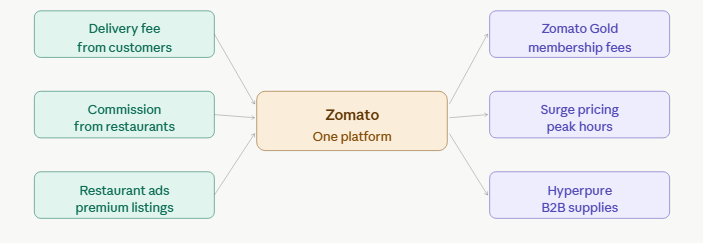
This is what separates companies that scale from companies that stay small. A single revenue stream is fragile. A business model that captures value in multiple ways from the same transaction is far more resilient.
The model determines everything
Here is what most people miss about business models — the model you choose determines what you optimise for, who your real customer is, and how your company behaves.
Netflix’s subscription model means the company is obsessed with reducing churn. Every rupee they spend on content is an attempt to make you less likely to cancel next month. Their enemy is cancellation, not competition.
Google’s advertising model means the company is obsessed with keeping you on the internet longer. More time online means more searches means more ad revenue. Their product is search but their business is time.
As we explored in the CRED breakdown, CRED’s model meant the company was never really in the rewards business — it was in the data business. The rewards were just the mechanism for attracting the right kind of customer. Understanding that distinction is the difference between seeing a company’s surface and understanding its actual logic.
Why startups get this wrong
Most early stage startups focus entirely on the product and treat the business model as something to figure out later. This is backwards.
The product is what you build. The business model is why building it makes sense as a company. Without a clear answer to “how does this create value and how do we capture some of it back,” you don’t have a startup — you have a project.
The most common mistake is assuming that because something is useful, people will eventually pay for it. Usefulness and willingness to pay are not the same thing. Water is the most useful substance on earth and most people expect it for free. Business models are not discovered automatically — they are designed.
What this means for you
Before writing the next line of code or the next piece of content, every founder should be able to answer three questions clearly.
Who are we creating value for? How are we creating it? And how do we capture enough of that value back to sustain and grow the business?
If you can answer all three cleanly, you have a business model. If any one of the three is vague, that vagueness will eventually become your biggest problem.
Understanding what a business model actually is — not a plan, not a pitch, but a system of value creation and capture — is the foundation everything else in business is built on.
Every concept we cover on CasualMBA, from pricing psychology to startup fundraising, is really just one part of this system looked at closely.
Understanding business means understanding the system behind it.
Startup takeaway:
“A business model isn’t what you build — it’s why building it makes sense as a company.”
Ready to test your understanding? Download the free Semester 1 Worksheet and apply every concept to a startup you know.