
What Is Product Market Fit — and Why Most Startups Die Without It
Every startup founder talks about product market fit. Investors ask about it in every meeting. Accelerators put it on every slide deck template.
Almost nobody explains what it actually means in practice.
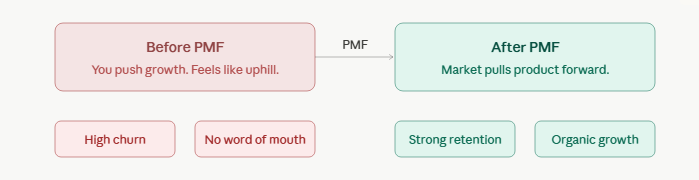
Product market fit — or PMF — is the point at which your product satisfies a strong enough demand in a specific market that the market itself starts pulling the product forward. You stop pushing and the product starts moving on its own.
That last sentence is the key. Before PMF, growth feels like pushing a boulder uphill. After PMF, it feels like the boulder is rolling and you’re running to keep up.
What product market fit actually is
The phrase was first defined clearly by venture capitalist Marc Andreessen, who described it simply as being in a good market with a product that can satisfy that market. Simple definition. Enormously difficult to achieve.
The reason PMF matters more than almost anything else in the early stage of a startup is captured perfectly in a concept we covered when looking at what a business model actually is — a business exists to create value for someone. PMF is the moment you confirm that the value you’re creating is valuable enough for a real market to want it consistently.
Without PMF, everything else is noise. Marketing spend is wasted. Hiring is premature. Fundraising buys you more runway to stay lost.
With PMF, almost everything gets easier. Users refer other users. Retention improves without effort. Investors come to you.
what is product-market fit
How you know you have product market fit
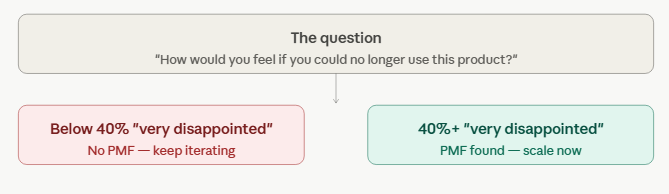
The most famous framework for measuring PMF comes from entrepreneur Sean Ellis, who created what is now called the Sean Ellis Test. The rule is straightforward — survey your active users and ask them one question: how would you feel if you could no longer use this product?
If 40% or more answer “very disappointed,” you likely have product market fit. If the number is below 40%, you don’t — regardless of how good the product feels from the inside.
This matters because founders are the worst judges of their own PMF. You built the thing, you believe in it. You see every positive signal and explain away every negative one. An external, measurable signal cuts through that bias.
Beyond the Ellis test, the clearest real-world signals of PMF are organic growth, strong retention, and unsolicited word of mouth.
WhatsApp never ran a single advertisement in its early years. It grew to hundreds of millions of users because people told other people — not because of any marketing strategy. That organic, unstoppable spread is what PMF looks like in practice. WhatsApp had found a market so hungry for simple, free messaging that the product essentially marketed itself.
Zepto is the Indian example worth studying closely. When Aadit Palicha and Kaivalya Vohra launched Zepto in 2021, quick commerce already existed in India. But they found that a specific segment of urban consumers — young professionals in metros — had an almost irrational demand for ten-minute grocery delivery. The retention numbers were extraordinary from the start. Users who tried it once came back compulsively. That compulsive return behaviour is one of the cleanest PMF signals a startup can have.
How you know you do not have product market fit
The signals of missing PMF are just as clear, and most founders encounter them and explain them away.
High churn is the most honest signal. If you are constantly acquiring new users but your overall user base is not growing meaningfully, users are leaving as fast as they arrive. That is not a marketing problem or an onboarding problem — it is a PMF problem. The product is not valuable enough for people to stay.
Low organic referral is another signal. If your existing users are not telling anyone about your product without being incentivised to do so, the product is not creating enough value to generate natural enthusiasm.
Pepsi Spire — Pepsi’s touchscreen soda customisation machine — is a clean example of a product that launched without PMF. The technology was impressive. The product was real. But consumers did not have a strong enough underlying need for customised soda in a fast-food context to make the behaviour stick. The product never found its market and was quietly discontinued. Building something technically impressive is not the same as building something the market actually wants.
The Instagram pivot — PMF found by accident
Instagram’s PMF story is one of the most instructive in startup history.
The original product was called Burbn — a location check-in app with gaming elements. It had features, it had users, and it had almost no traction. The founders studied their data closely and noticed one thing — the photo sharing feature within Burbn was being used disproportionately compared to everything else.
They stripped the entire product back to just photos, filters, and sharing. Instagram launched in October 2010 and reached one million users in two months. They had not invented a new idea — they had found the specific piece of their product that the market actually wanted and rebuilt everything around it.
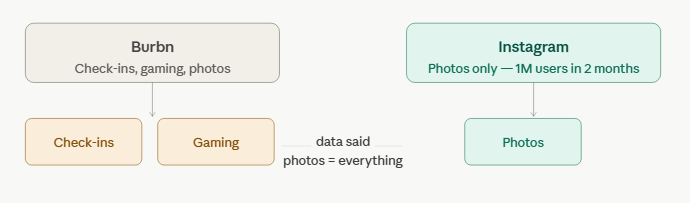
This is what finding PMF sometimes looks like. Not a triumphant launch moment but a quiet realisation in the data that one thing is working while everything else is not.
What to do before you find product market fit
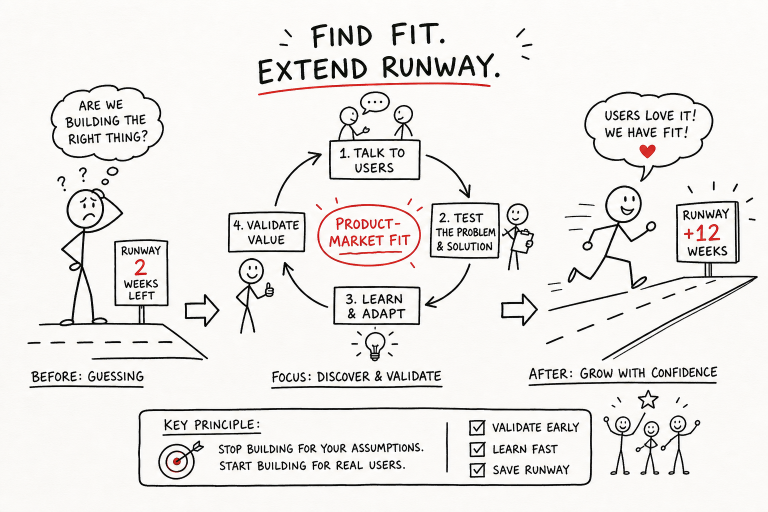
Before PMF, the only job of a startup is to find it. Everything else is secondary.
This means talking to users obsessively. Not to sell them, not to pitch them, but to understand exactly what problem they are trying to solve and how painful that problem actually is. The mistake most founders make is building features based on what users say they want rather than observing what users actually do.
It means staying lean. Scaling a team, raising large rounds, and building complex infrastructure before PMF is one of the most common ways startups die. You are scaling something that does not yet work. As we explored when looking at why people pay for convenience over products, people pay for things that solve real pain — not for things that are merely useful in theory.
It also means being willing to pivot. The Instagram story is not unique. Many of the most successful products in the world are not what their founders originally intended to build. PMF requires honesty about what the data is telling you, even when the data contradicts the original vision.
What to do after you find product market fit
After PMF, the job changes completely. Now the goal is to scale what is working without breaking it.
This means hiring to accelerate the growth that is already happening, not to create growth artificially. It means raising capital to pour fuel on a fire that is already burning, not to search for a spark. It means building the operational infrastructure to handle demand that the market is already generating.
The founders of Zepto understood this. Once they confirmed their retention numbers in Mumbai, they did not experiment further — they raised capital aggressively and expanded to new cities as fast as operationally possible. The PMF was confirmed. The job became execution.
The one question that cuts through everything
If you are building something right now, there is one question that tells you more about your PMF status than any metric or framework.
Would your users be genuinely upset if your product disappeared tomorrow?
Not mildly inconvenienced. Not slightly annoyed. Genuinely upset — the way people were upset when Google announced it was shutting down Google Reader and hundreds of thousands of users signed petitions to keep it alive. That reaction is PMF. That is a market telling you it needs what you built.
If the honest answer is that most users would simply move on without much trouble, you do not have product market fit yet. And that is not a failure — it is information. The most valuable information an early stage startup can have.
Find that feeling first. Build everything else second.
Understanding business means understanding what the market actually wants — not what you think it wants.
Startup takeaway:
“PMF is not a feeling. It is the moment the market starts pulling your product forward without you pushing.”
Ready to test your understanding? Download the free Semester 1 Worksheet and apply every concept to a startup you know.