Is Paid Social Worth It for Startups?
You boosted a post. Spent $300. Got a bunch of likes, maybe a few comments, and then watched the results screen like it owed you money. Sound familiar? Is paid social worth it for most startups, or is that confusion after the first campaign just the beginning of a longer, more expensive lesson? The confusion itself is the real problem, not paid social.
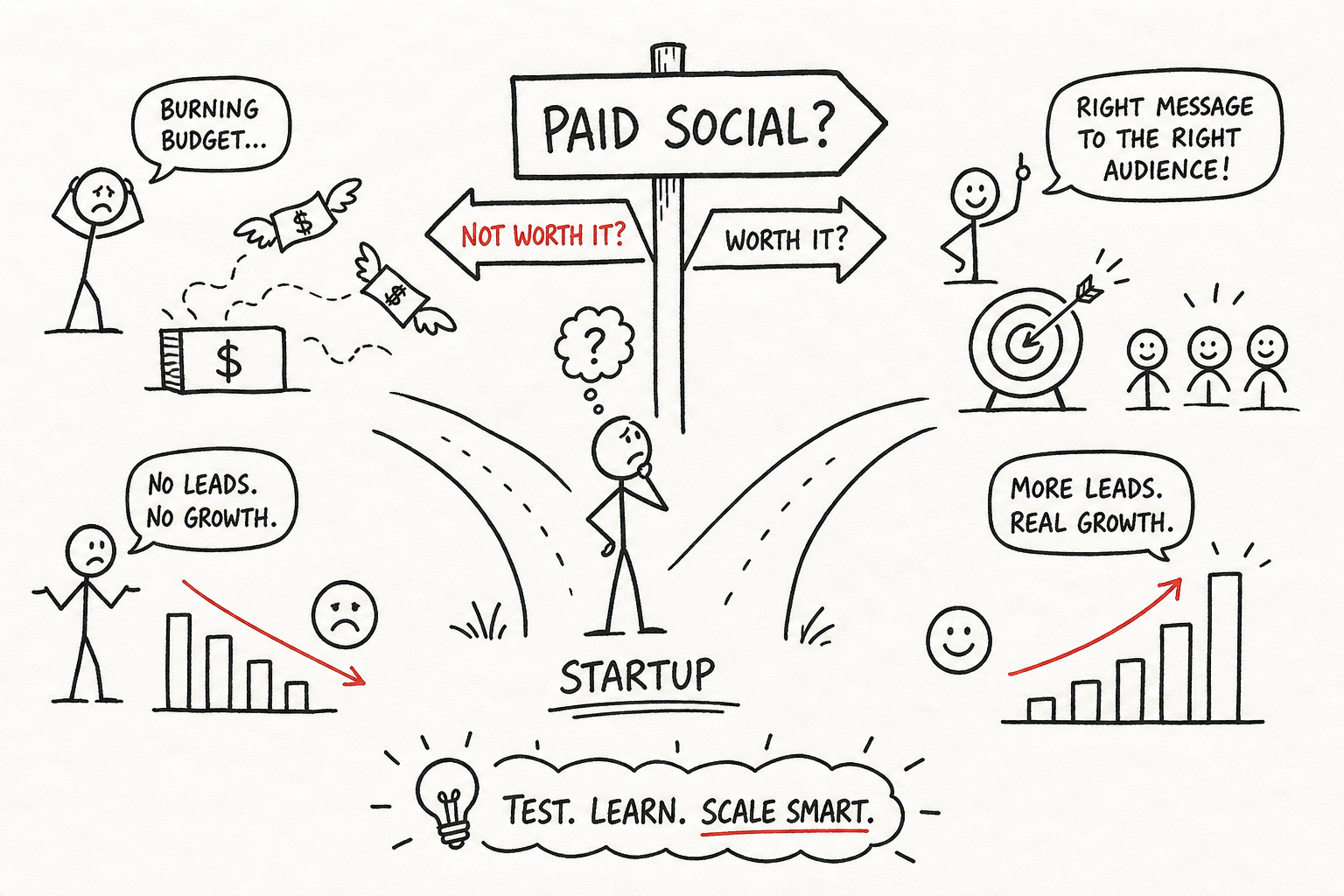
Paid social is not inherently good or bad for startups. Whether it’s worth your money depends almost entirely on where you are in your growth stage and whether your unit economics can actually support the spend. Founders tend to fall into two camps: those who throw budget at ads before they’ve validated anything (hoping ads will solve a product problem), and those who avoid paid entirely because they’re scared of burning cash. Both camps are making a costly mistake, just in different directions.
This is exactly the kind of growth strategy tradeoff the CasualMBA newsletter unpacks every week using real startup examples, no jargon, no fluff. If you want a plain-English breakdown of decisions like this one delivered to your inbox, that’s where to find it. Here’s how to figure out if paid social belongs in your budget.
What “Worth It” Actually Means for an Early-Stage Startup
CAC, LTV, and the Ratio That Determines Everything
The only lens that matters when evaluating paid social advertising is unit economics. Specifically: is your customer acquisition cost (CAC) materially lower than your customer lifetime value (LTV)? A healthy CAC:LTV ratio is typically 1:3 or better. That means if a customer is worth $150 to your business over their lifetime, you can afford to spend up to $50 acquiring them and still have a sustainable model. Spending $65 to acquire a $50 customer is not growth, it’s a slow leak toward zero.
The math sounds obvious, but it’s a step many early founders skip. They see a low CPC and assume the channel is working without ever connecting it back to actual revenue per customer. Know your LTV before you run a single ad. Everything else flows from that number.
Is Paid Social Worth It Before Product-Market Fit?
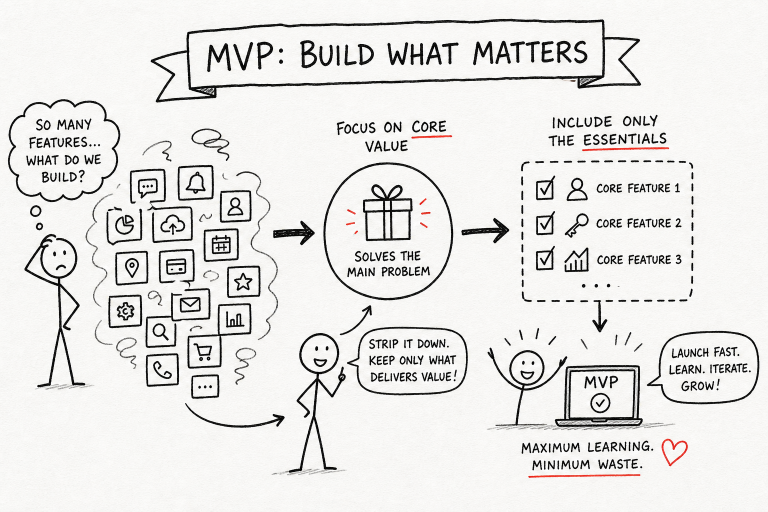
There’s a clean line between pre-PMF (before product-market fit) and post-PMF, and it matters enormously here. Before you’ve found product-market fit, paid social doesn’t fix a broken conversion funnel, it just sends more traffic into it. You end up paying to confirm what your analytics already told you for free: people aren’t converting. After PMF, when you know your customer converts, retains, and refers others, paid social becomes a volume dial you can turn up with confidence.
The job before PMF is to find and understand your customer. Paid social is a tool for reaching them at scale, not discovering who they are. Direct conversations, content tests, and organic channels are cheaper and faster for that phase. Turn on paid spend once you have something worth amplifying.
What the 2026 Platform Benchmarks Actually Show
Meta and Instagram: Still the Default for Consumer Brands
Based on 2026 industry benchmark reports, Meta averages a 4.2x ROAS across Facebook and Instagram combined, with eCommerce CPA running $38 to $65 per purchase. Instagram specifically shows strong performance for beauty and consumer products, with reported ROI around 420% overall and 518% for beauty brands. Meta’s retargeting capabilities and audience depth make it the most versatile starting point for consumer-facing startups, but competition for attention is rising, and so is the floor.
For direct-to-consumer startups, average CAC on paid social advertising typically lands between $70 and $150 depending on category and funnel quality. That number only works if your LTV supports it. A $75 CAC on a $200 average order value with repeat purchases looks very different from a $75 CAC on a one-time $80 purchase.
TikTok’s CPM Edge vs. LinkedIn’s B2B Premium
TikTok offers the lowest CPM at roughly $3.50 to $7, making it useful for awareness and brand-building. Its reported ROAS of 2.8x trails Meta, which means you’re getting cheap reach but fewer efficient conversions. LinkedIn sits at the opposite extreme: CPC runs $6 to $12, CPL hits $60 to $140, and ROAS reaches 3.1x for B2B lead generation. Painful upfront, but the lead quality for decision-maker targeting in SaaS or professional services often justifies it.
Platform choice should match the buyer, not your personal feed preference. A consumer startup targeting Gen Z can’t ignore TikTok’s reach economics. A B2B startup selling to operations managers has no business burning budget on TikTok discovery ads. Match the channel to where your customer already spends their attention. For a concise overview of relative platform ROI and where each channel tends to perform best, see this guide to the best social media platforms for ROI.
| Platform | Key Metrics (2026 Benchmarks) | Best For | Key Takeaway |
|---|---|---|---|
| Meta (Facebook + Instagram) | ROAS: 4.2xeCommerce CPA: $38–$65Instagram ROI: 420% overallBeauty Brand ROI: 518% | Consumer brands, eCommerce, DTC startups | Strongest all-round platform thanks to powerful targeting, retargeting, and audience depth. |
| ROI: 420%Beauty ROI: 518% | Beauty, fashion, lifestyle, consumer products | Particularly effective for visually-driven consumer brands. | |
| TikTok | CPM: $3.50–$7ROAS: 2.8x | Brand awareness, Gen Z audiences, top-of-funnel marketing | Cheapest reach among major platforms, but conversion efficiency trails Meta. |
| CPC: $6–$12CPL: $60–$140ROAS: 3.1x | B2B SaaS, professional services, lead generation | Higher acquisition costs but superior access to decision-makers and business buyers. | |
| Paid Social (Average DTC) | CAC: $70–$150 | Direct-to-consumer startups | CAC only makes sense when supported by strong customer lifetime value (LTV). |
When Paid Social Actually Accelerated Startup Growth
Dollar Shave Club: Paid Amplification on a Proven Hook
Dollar Shave Club’s 2012 launch video spread rapidly through organic sharing, but the company didn’t stop there. They used digital marketing and paid channels to amplify content that was already generating demand, pushing it in front of audiences who matched their proven customer profile. The critical detail: the unit economics were in place before spend scaled. The product had low manufacturing costs, the subscription model created predictable LTV, and the brand voice was distinct enough that every ad reinforced it rather than diluting it.
Paid social accelerated growth because the foundation was already solid. They weren’t testing whether the product resonated, they were scaling a machine that already had product-market proof. The lesson isn’t that paid social caused the growth; it’s that paid amplification only compounds when the underlying model already works.
Glossier: Organic First, Paid as a Scale Lever
Glossier did the opposite sequencing and arrived at the same principle. Emily Weiss spent years building a loyal readership through Into The Gloss before Glossier launched a single product. By the time paid social ads entered the picture in their scaling phase, the brand already had social proof, a distinct aesthetic, and a word-of-mouth loop running on its own. Paid media didn’t create their growth, it amplified organic momentum that already existed.
The lesson from both examples is the same: paid social is a multiplier, and multiplying zero still gives you zero. You need something working before you pay to scale it.
When Paid Social Quietly Drains Your Runway Instead
The Pre-PMF Trap Most Early Founders Fall Into
Founders often turn to paid social when organic traction is slow, treating ads as a way to discover whether their product resonates. That’s an expensive approach to market research. A startup running even a modest paid social test on Meta before they can reliably convert organic traffic is paying for data they should be gathering through direct customer conversations and content testing. If your landing page converts under 1% from warm traffic, buying cold paid traffic will produce worse numbers at a higher cost, cold social benchmarks typically land between 0.5% and 1.5%, so a weak warm baseline leaves almost no margin.
Industry social ad benchmarks are consistent on this point: cold social traffic converts at 0.5% to 1.5% on average, and that ceiling only gets lower when the funnel itself is broken. Fixing the funnel means tightening your headline, simplifying your offer, and reducing friction between click and conversion, steps that cost nothing but time. Fix those first, then scale the spend.
When Organic Content Genuinely Beats Paid on Unit Economics
For early-stage startups with limited runway, organic content often delivers a better CAC simply because the cost per lead is near zero after creator time. Brands in niche communities, B2B startups with a strong LinkedIn presence, and founder-led brands with an engaged audience frequently see organic CAC of $10 to $30 compared to paid CAC of $40 to $80. That’s a meaningful gap when every dollar of runway counts.
Is Paid Social Worth It? How to Run a Lean Test That Gives You Real Data
The Minimum Structure That Produces Reliable Signal
A meaningful paid social test requires a minimum of $300 to $1,500 in total spend, run over at least two weeks. The structure that generates usable signal without overcomplicating things: one platform, three distinct audience segments, two creative variations per audience, and a single clear conversion objective. Spreading budget thinner than this produces data that looks conclusive but isn’t. You need at least 20 to 30 conversions or 100 clicks per test variant to make a defensible decision.
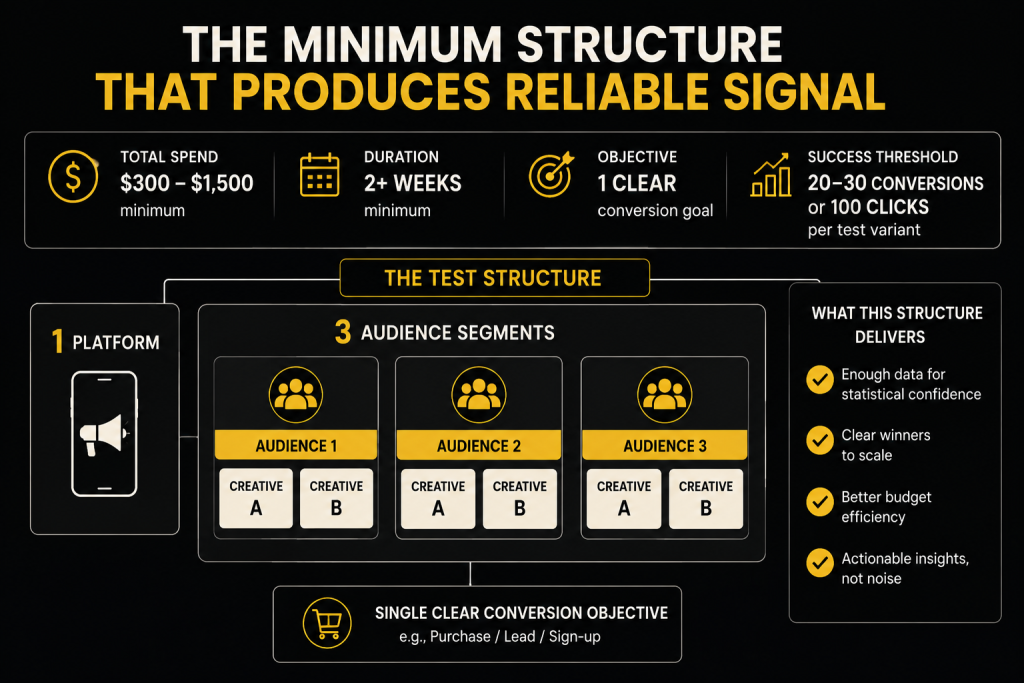
Resist the urge to test everything at once. Testing audience, creative, placement, and copy simultaneously makes statistical confidence nearly impossible on a small budget. Pick one platform, keep the structure lean, and let the data breathe.
What to Measure and When to Call It
The metrics that matter at the test stage are CPA (cost per acquisition), CTR to diagnose creative performance, and landing page conversion rate to separate ad quality from funnel quality. If your CPA comes back at 3x your target and creative CTR is below 1%, treat those as rough heuristics pointing to an ad problem. When CTR is strong but CPA stays high, the problem is the landing page, not the ad. Knowing the difference saves you from cutting a paid channel that would have worked with a better post-click experience.
Don’t optimize what isn’t broken, and don’t abandon what hasn’t been properly tested. Run the test long enough to hit your conversion minimums, read the right metrics, and then make a decision based on data rather than impatience.
The Verdict: A Simple Framework to Decide
So, is paid social worth it? Here’s the short answer: it depends on three things. Do you have evidence of product-market fit? Is your landing page converting above 2% from warm traffic? Is your LTV at least 3x what you expect to pay per acquisition? If yes to all three, paid social is worth testing at a low floor. If you can’t answer yes to any one of those, the budget is better spent on organic and direct channels that help you answer them first.
Paid social is not a growth engine for early startups. It’s a growth accelerator for startups that already have something working. Founders who treat it as a shortcut to product validation burn runway and walk away convinced the channel doesn’t work. Founders who use it to scale a model they already understand turn it into their most efficient acquisition lever.
Get the foundation right, then turn on the spend. And if you want a plain-English breakdown of growth decisions like this one every week, with real startup case studies instead of abstract frameworks, the CasualMBA newsletter is where to find it. Real growth decisions, explained plainly. No frameworks that require a decoder ring.
For additional context on 2026 platform benchmarks and ad performance across channels, see this 2026 platform ROI guide.