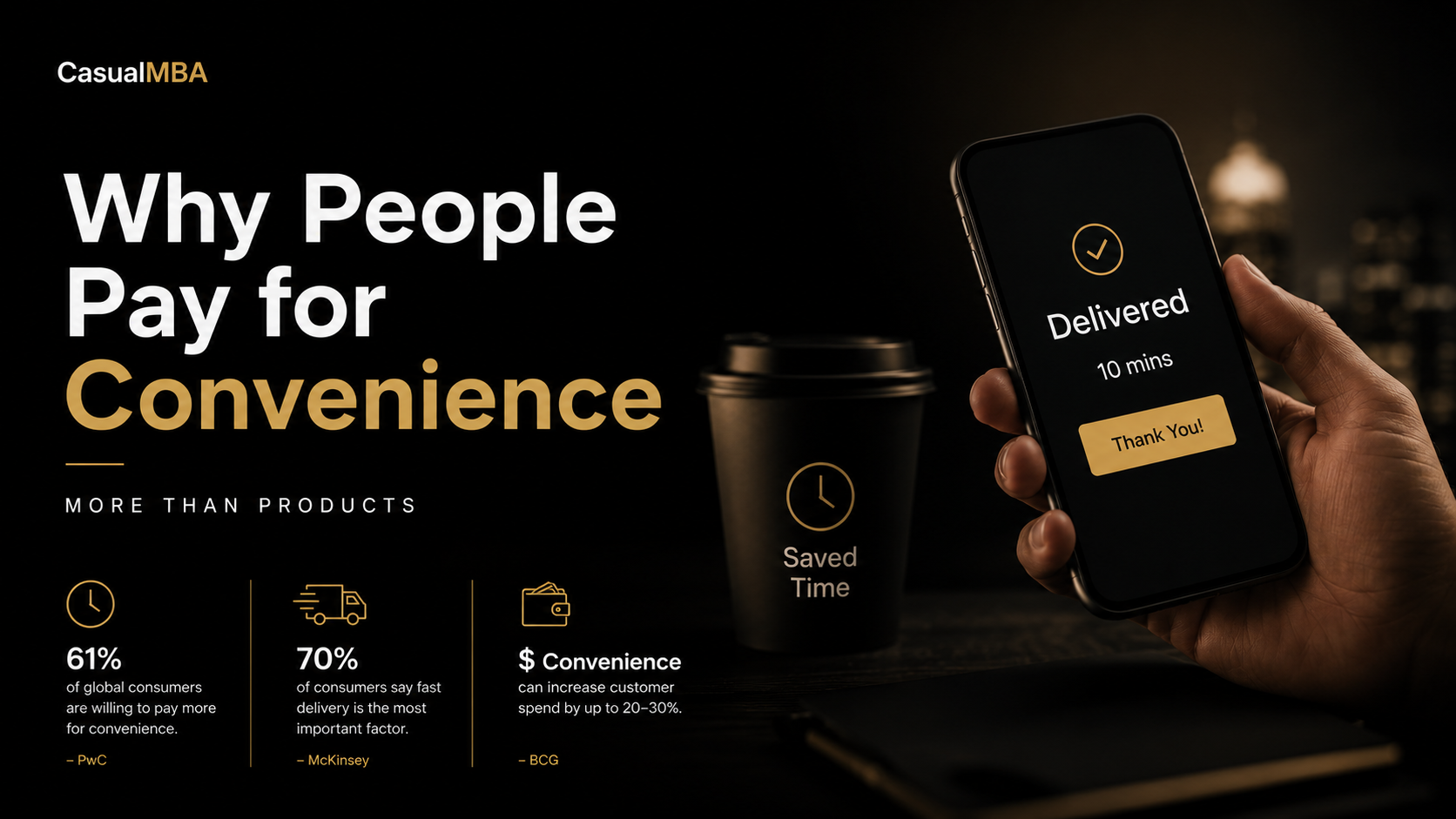
Why People Pay for Convenience More Than Products
Nobody really wants food delivery apps.
People want to avoid cooking after a long day.
Nobody actually pays ₹499 for “10-minute delivery.” They pay to avoid waiting.
That’s one of the most important ideas in business:
people rarely buy the product itself. They buy a better version of their current situation.
And in modern business, convenience has quietly become one of the most powerful products in the world.
Convenience Changes Human Behavior
For most of history, convenience was considered a luxury. Today, it’s becoming an expectation.
People now expect:
- instant replies
- same-day delivery
- one-click payments
- auto-saved passwords
- streaming instead of downloading
- AI tools instead of manual work
Once humans get used to convenience, they rarely want to go backwards.
That’s why businesses built around reducing effort often grow incredibly fast. Convenience changes habits, and habits create recurring customers.
The Best Businesses Remove Steps
If you look closely, many successful companies are simply reducing the number of decisions people need to make.
Uber removed the need to:
- search for taxis
- negotiate prices
- handle cash
- explain directions repeatedly
Amazon reduced the effort involved in shopping physically.
Netflix removed waiting schedules, DVD rentals, and television timing.
Even AI tools are fundamentally convenience products. They reduce:
- research time
- writing effort
- design work
- repetitive thinking
The easier something feels, the more valuable it often becomes to users.
People Pay More to Think Less
This is where consumer psychology becomes interesting.
Most purchasing decisions are emotional first and logical later. Human beings naturally move toward options that reduce:
- mental effort
- uncertainty
- friction
- waiting
That’s why pre-cut vegetables cost more than regular vegetables.
It’s why people spend extra money on airport food even when they know it’s overpriced.
It’s why subscription services became so dominant. Automatic billing removes the effort of repeatedly deciding whether to purchase again.
Convenience is not only saving time. It’s reducing mental load.
And modern consumers are often mentally exhausted.
Speed Became Part of the Product
Earlier, businesses mainly competed on quality and price.
Now they also compete on speed. Food apps promise delivery in 10 minutes. Streaming platforms instantly autoplay the next episode.
E-commerce companies compete over same-day shipping. Even social media platforms are optimized around instant gratification.
The internet trained people to expect minimal delay between desire and fulfillment.
Businesses that understand this usually outperform slower competitors, even when the actual product difference is small.
Convenience Often Beats Quality
This sounds irrational, but it happens constantly.
Many people prefer:
- fast food over healthier food
- quick content over deeper content
- online shopping over local stores
- voice notes over typing
- short videos over long explanations
Convenience frequently defeats quality because humans naturally conserve energy.
A slightly worse solution that feels easier often wins against a better solution that feels complicated.
This is one reason why technically superior products sometimes fail in the market. Consumers do not always choose the “best” product. They choose the easiest experience.
The Regret Loop
Here’s something businesses rarely talk about openly. People often feel guilty paying for convenience. Ordering food instead of cooking feels lazy. Paying someone to do something you “should” do yourself feels embarrassing.
Buying the easier option when the harder one exists feels like a small personal failure. This guilt is friction too.
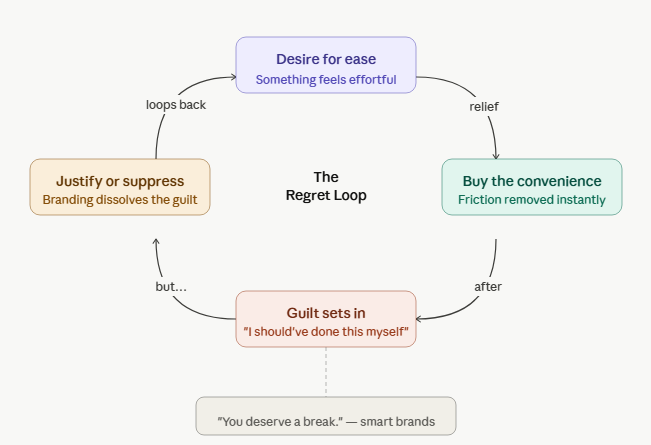
And it quietly stops people from making purchases they actually want to make.
The smartest businesses figured this out early.
They don’t just sell convenience. They reframe it.
- “You deserve a break.”
- “Spend time on what matters.”
- “Let us handle the rest.”
That language isn’t accidental. It’s designed to dissolve guilt before it becomes hesitation.
Because the real competition isn’t always a rival brand.
Sometimes it’s the customer’s inner voice saying: you shouldn’t need this.
The businesses that silence that voice — through branding, community, or simple reassurance — convert far better than those that don’t.
Businesses Learned to Sell Time
In many ways, modern businesses are no longer selling products.
They are selling:
- saved time
- reduced effort
- smoother experiences
- fewer decisions
That’s why premium convenience businesses work so well.
People happily pay extra for:
- priority delivery
- premium memberships
- business-class travel
- automation software
- concierge services
As people become busier and more digitally overloaded, time itself becomes more valuable.
The companies that save people time often become extremely profitable.
Convenience Creates Dependence
There’s another side to this.
The more convenient a platform becomes, the harder it is for users to leave.
Once people become used to:
- one-click ordering
- algorithmic recommendations
- instant entertainment
- cloud storage
- AI assistance
manual alternatives start feeling frustrating. This creates powerful business advantages. Convenience doesn’t just attract users. It changes expectations permanently.
That’s why large tech companies invest aggressively in making experiences feel frictionless. The smoother the system becomes, the more deeply users integrate it into daily life.
The Forgetting Tax
Subscription businesses discovered something interesting.
Convenience doesn’t just make people buy more easily.
It makes people forget they’re buying at all.
Automatic billing removes the moment of decision. No prompt, no reminder, no friction.
And without friction, people rarely pause to ask:
- Do I still use this?
- Is this worth the money?
- Should I cancel?
That pause never comes. So the payment continues.
Netflix, Spotify, gym memberships, SaaS tools — many of these businesses quietly depend on a percentage of users who forgot they subscribed.
This is sometimes called passive retention. The product didn’t earn the renewal. The system just made cancelling slightly inconvenient.
Convenience designed for the user eventually becomes convenience designed against them.
That’s a thin line. And the most honest businesses are the ones who acknowledge it.
Why This Matters for Business
One of the biggest mistakes new founders make is obsessing over features instead of friction.
Customers often care less about:
- complexity
- technical sophistication
- innovation buzzwords
than they do about:
- simplicity
- ease
- speed
- clarity
Sometimes the winning business idea is not creating something entirely new.
It’s simply making an existing process less annoying.
That sounds simple, but entire billion-dollar companies were built exactly that way.
So Why Do People Pay for Convenience?
Because convenience reduces effort, and humans are naturally drawn toward easier experiences.
People don’t just buy products anymore. They buy:
- saved time
- reduced stress
- faster outcomes
- mental relief
The businesses that understand this deeply tend to grow faster because they align with something fundamentally human:
the desire to make life feel easier.
And honestly, that may be one of the most important forces shaping modern business today.
Ready to test your understanding? Download the free Semester 1 Worksheet and apply every concept to a startup you know.