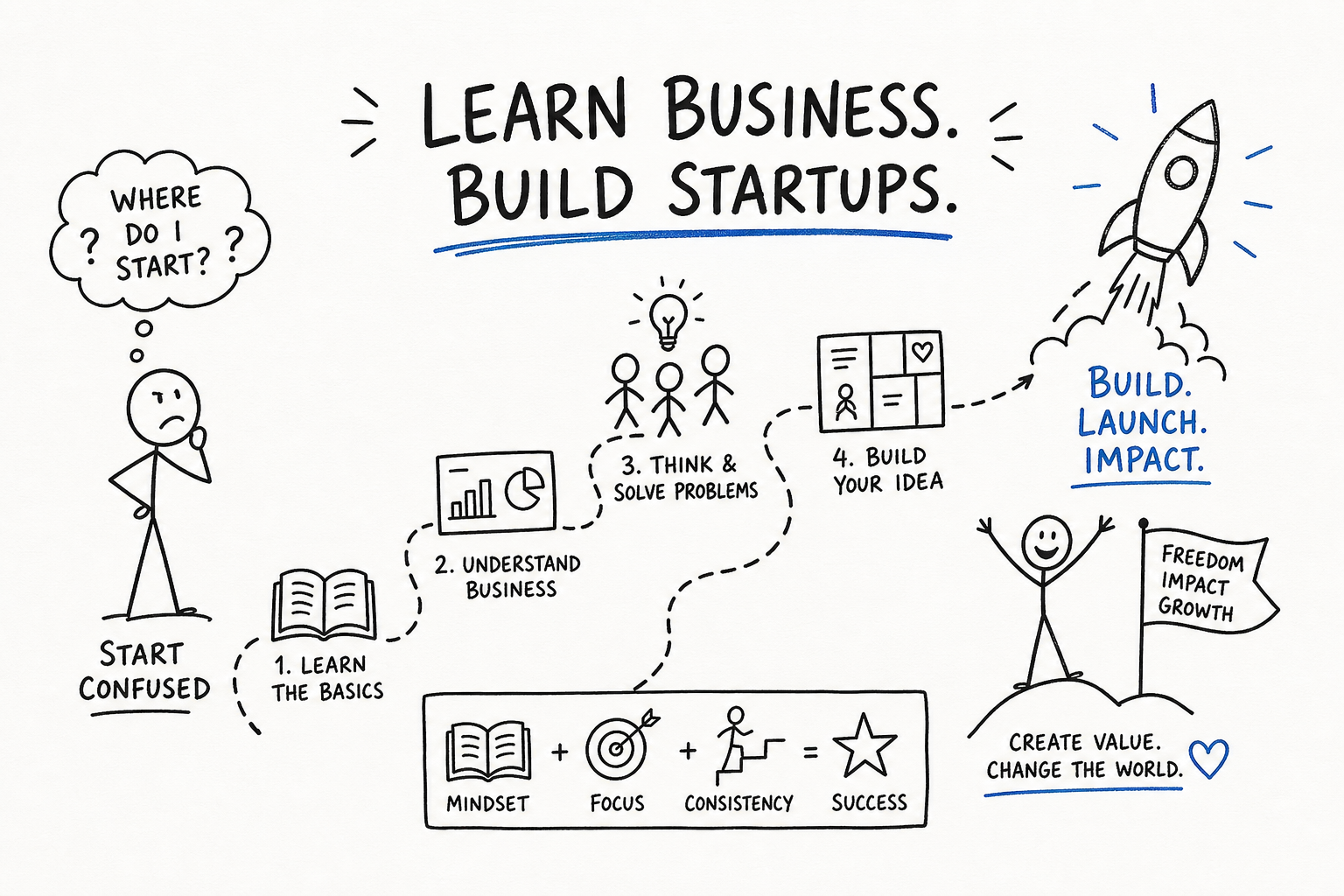
How to Start Learning Business and Startups From Scratch
How do I start learning about business and startups from scratch? It’s one of the most common questions aspiring founders ask, and one of the least well-answered. Most people who want to build a startup don’t lack ambition. They lack a starting point. The internet is overflowing with business content, yet almost none of it tells you what to learn first, what to safely skip for now, and in what order the pieces should come together. The result is analysis paralysis dressed up as research.
Here’s the good news: you don’t need an MBA, a business degree, or a wealthy mentor to start thinking like a founder. You need a handful of core concepts, a clear sequence, and the discipline to apply them to real companies. That’s the whole game at the beginning. Think of this article as your map for the first 90 days of building real business fluency, a beginner business learning plan that cuts through the noise and gives you a concrete place to start.
Quick answer: If you’re asking how to start learning about business and startups from scratch, begin with three foundational concepts, business models, unit economics, and customer acquisition, then follow a 30/90-day self-study plan to go from theory to your first validated idea. The sections below walk you through exactly that.
Why most beginners approach learning about business and startups the wrong way
The most common beginner mistake is starting with tactics before understanding how businesses actually work. People jump straight into “should I form an LLC or an S-corp?” or “which social media platform should I focus on?” These are real questions, but they’re meaningless without a working mental model of how a business creates value, delivers it, and captures a piece of it as revenue. Every tactic you learn without that foundation is a loose brick with no wall to attach it to.
There are hundreds of business frameworks out there, and most beginner courses will throw all of them at you at once. But three concepts do the actual heavy lifting for startup thinking: business models, unit economics, and customer acquisition. Many other important topics, product strategy, fundraising, growth loops, and pricing, build on these three. Learn them properly and the rest of the curriculum starts to organize itself naturally. That’s where this guide starts.
Business models: how companies like Airbnb actually make money
A business model is the logic of how a company creates value for customers and captures some of that value as revenue. It’s not the same as a business plan, and it’s not a mission statement. Airbnb doesn’t own a single property. It built a two-sided marketplace where hosts and guests transact, then takes a service fee from both sides: roughly 3 to 5 percent from hosts and up to 20 percent from guests per booking. Stripe connects developers to payment infrastructure and charges a percentage on every transaction processed. Both companies are worth billions, and neither was first in their category. They designed a smarter model around a problem that already existed.
For any beginner working through a startup roadmap for beginners, the goal is pattern recognition across five core model types:
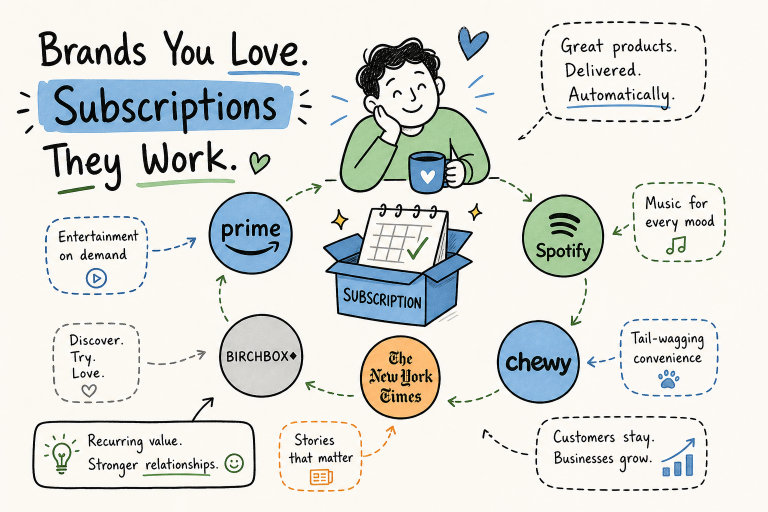
- Subscription: recurring fees for ongoing access (Netflix and Spotify are the obvious examples)
- Marketplace: connects buyers and sellers and takes a cut, like Airbnb or eBay
- SaaS: software delivered as a service, usually via subscription
- Transactional: charges per sale or action
- Freemium: a free tier that converts a percentage of users to paid over time
Once you can spot which model a business uses, you start asking sharper questions about every company you encounter.
Choosing the wrong model is a frequently observed early-stage mistake, and it often happens before a single line of code gets written. Consider a simple note-taking tool. As a one-time purchase, it generates revenue upfront but nothing recurring. A subscription version produces predictable monthly cash flow but requires ongoing value delivery to reduce churn. With a freemium model, the business trades short-term revenue for user growth and conversion leverage later. The product remains the same, but its financial behavior changes completely. The model you choose shapes everything downstream.
Unit economics: the math behind whether your idea can actually work
Unit economics is the financial story of one customer. CAC, or customer acquisition cost, is how much you spend to acquire a single customer. LTV, or lifetime value, is how much total revenue that customer generates over their relationship with you. When LTV meaningfully exceeds CAC, a ratio of roughly 3:1 is a common benchmark for recurring businesses, the model has a viable foundation. If it doesn’t, you’re losing money on every customer you bring in, and growing faster just accelerates the problem. Keep in mind that LTV and CAC are necessary starting points, but gross margin and cash payback period also matter when evaluating overall health.
Consider how the developer-led acquisition model works at a company like Stripe. The logic is clear: a developer who adopts a payment tool doesn’t just bring one account. They bring the whole team, and then the next company they join. That reasoning justifies heavy investment in developer experience, documentation, and community before massive revenue arrives. The unit economics make the spending rational, and understanding that logic is exactly what separates a founder who spends strategically from one who burns money and wonders why. As a solo founder, you can apply the same LTV thinking to your own early customer profile: who in your target audience is most likely to stick around, refer others, and grow with you?
You don’t need a spreadsheet on day one, but you do need to think through the rough math. If you spend 50 dollars in ads and time to acquire one customer who pays 20 dollars and never returns, the model doesn’t work regardless of how good the product is. A simple back-of-napkin test: estimate what it costs to reach one customer (time, ads, referrals), estimate what that customer will pay and for how long, then check whether the numbers even make sense in theory. If they don’t work on paper, they won’t work in practice.
Customer acquisition: how startups actually get their first users
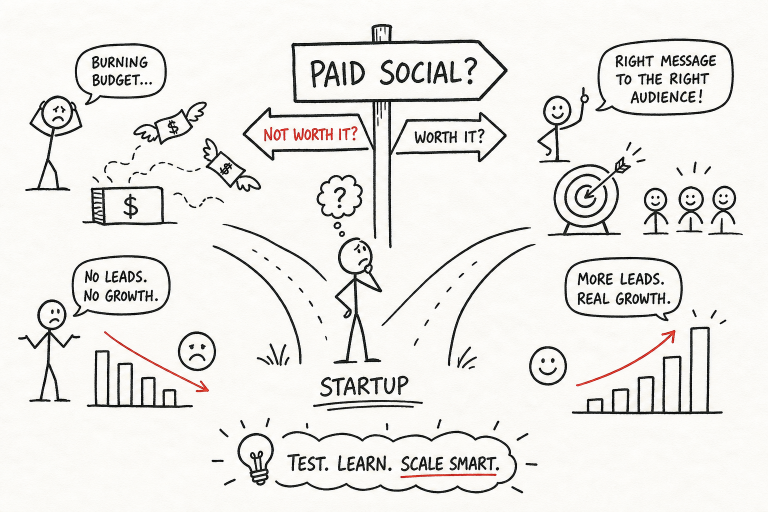
Early-stage customer acquisition almost never starts with paid advertising. It starts with doing things that don’t scale. Airbnb’s founders went door to door to photograph listings themselves in the early days. They also engineered an integration with Craigslist to tap into a massive existing audience without a marketing budget. The first 100 customers came from hustle and ingenuity, not a media spend. That’s not an exception to the rule, it is the rule for early-stage founders.
One of the most valuable lessons beginners miss is that not all customers are equal. Acquiring 1,000 users with a passing interest in your product is worse than finding 50 who genuinely can’t live without it. This is the concept of an ideal customer profile, or ICP: a specific description of the person most likely to get real value from your product, buy it, and stick around. The clearer your ICP, the more focused your acquisition effort, and the better your early retention data.
Before any acquisition strategy, the single most important thing a new founder can do is talk to potential customers. Five to ten real conversations with target users will reveal more about the problem, willingness to pay, and competitive alternatives than any course. The questions that matter: What do you currently do to solve this problem? How painful is it on a scale of one to ten? What would you give up to make it go away? The answers will reshape your model, your messaging, and your feature priorities before you’ve built anything.
How do I start learning about business and startups from scratch? Your 30/90-day plan
This is the section that turns the question into action. Here’s a phased beginner business learning plan built around the three concepts above.
Days 1, 30: Build the mental model
The first 30 days are about building the mental model, not building the product. Focus entirely on the three core concepts above. Read one business case per week using companies you already follow and ask the same question each time: how does this company actually make money? Complete at least one real customer discovery conversation by the end of the month, even a 20-minute call counts.
For structured learning, lean on these free resources:
- MIT OpenCourseWare’s Entrepreneurship 101, widely referenced for customer discovery and early-stage startup thinking
- MOBI (My Own Business Institute), a self-paced startup curriculum available at no cost
- HubSpot Academy, solid coverage of marketing fundamentals for beginners
- CasualMBA, applies one business concept to one real company per week, so the ideas stay concrete rather than abstract as you work through the other resources
For a practical timeline you can follow as you move from learning to doing, see a concise guide on how to structure your first 90 days, it complements the plan above with daily and weekly milestones.
Days 31, 90: Move into execution
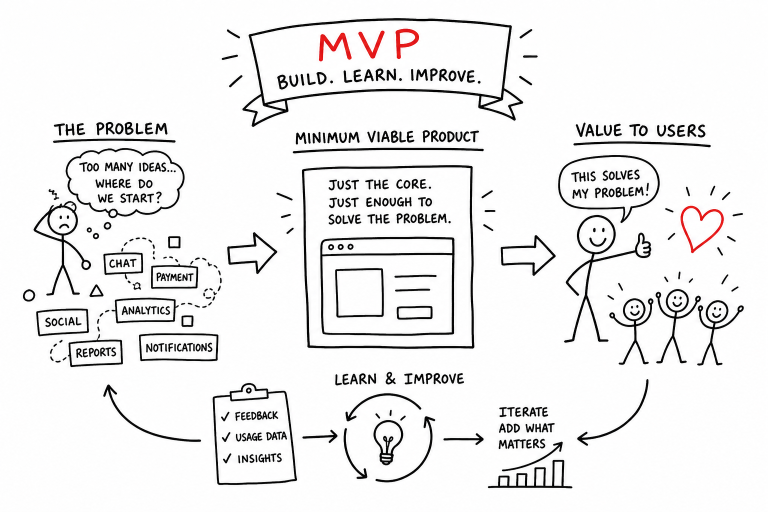
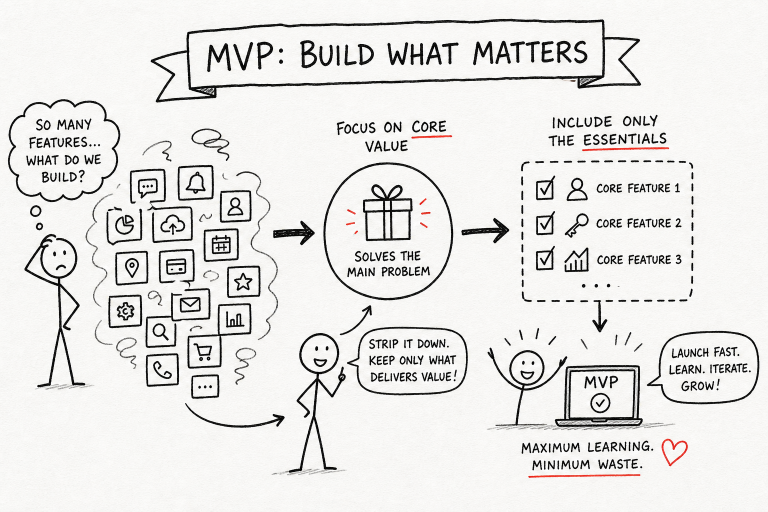
Days 31 through 90 shift into execution mode. Pick one idea and run a real validation test: write a clear problem statement, talk to five more potential customers, and build a landing page or concierge MVP to measure actual demand. A concierge MVP means delivering the service manually to a small group before automating anything, it lets you learn the real workflow and customer pain points directly, without building a full product first. Track one metric during this phase: sign-ups, pre-orders, or direct replies. One piece of real evidence that someone wants what you’re building is worth more than a hundred hours of additional research.
Also handle the basic administrative setup during this period. These tasks are not exciting, but they are important.
Registering your business entity and opening a dedicated bank account can often be done quickly. Taking care of them early helps prevent administrative headaches later. It also reduces the risk of problems appearing at the worst possible moment. For a practical checklist covering entity registration, bank accounts, and early bookkeeping, see this how to set up a business checklist. Set up simple bookkeeping while you’re at it. The goal by day 90 is concrete: a validated problem, real customer conversations on record, a tested MVP or prototype, and a legal structure ready to operate.
If you want a step-by-step overview of the startup launch process alongside execution advice, this 10-step guide to starting your startup business is a useful companion resource.
The starter toolkit every beginner needs
Four practical tools cover everything a new founder needs in the first 90 days. A customer interview script structures discovery conversations so you’re gathering comparable data, not just chatting. A lean business plan template captures the model, target customer, and key assumptions on one page without the 40-page document nobody reads. A basic financial model translates your CAC and LTV assumptions into real numbers so you can see whether the math works before you commit significant time or money. A simple pitch framework only becomes necessary once the model is validated, but it’s useful to have a structure ready.
None of these need to be elaborate. A Google Doc version of each is enough to start. The point is to externalize your assumptions so you can test and refine them, not to produce polished documents. The founders who succeed aren’t the ones with the most sophisticated spreadsheets. They’re the ones who got their assumptions in front of real customers faster than anyone else, which is consistent with what lean startup research has emphasized for over a decade.
For an accessible one-page option you can copy and adapt right away, grab a free free business plan template, it’s a practical place to capture your lean plan and testable assumptions.
For ongoing learning beyond the first 90 days, focus on one resource per week. That approach is usually more effective than starting five courses and finishing none. CasualMBA is built around this rhythm. Each week covers one concept, one real company, and one clear takeaway. Over six months, those lessons add up to a practical business education without the noise.
Start with one question this week
If you’re still asking yourself how do I start learning about business and startups from scratch, here’s the honest answer: start smaller than you think you need to. You don’t need a degree, a fully formed idea, or a business plan. Pick one company you genuinely admire and ask yourself this week: how do they actually make money? Trace the full logic from customer value to revenue capture. That single question, asked consistently about the companies around you, is where startup thinking begins, and where this 90-day plan takes root.
The best founders aren’t necessarily the smartest people in the room. They’re the ones who kept learning and testing after everyone else got distracted or discouraged. Start with the business model concept this week. Everything else builds from there.
Ready to teach yourself startups one concept at a time? CasualMBA breaks down one real business idea per week using companies you already know. It’s the simplest way to build a practical business education from scratch, no MBA required. Start reading here.