What Is a Minimum Viable Product in Software Development
Minimum viable product software development exists to answer one question before you over-invest: do real people actually want this thing? Many founders spend six to twelve months building a product before a single paying customer has touched it. They add features to feel productive, polish the UI to feel ready, and convince themselves they’re one sprint away from launch. Then they ship, and nobody shows up. The product wasn’t what people wanted. The problem wasn’t as painful as assumed. Months of engineering work go straight into the recycling bin.
This is exactly the trap that minimum viable product thinking exists to prevent. The MVP framework, popularized by Eric Ries and the lean startup movement, is the most practical tool in any founder’s toolkit for testing core assumptions before serious money hits the table. At CasualMBA, we break down startup frameworks like this one every week in plain English, using real company examples so the concept actually sticks. No CS degree required. No business school textbook. Just the framework, how it works, and how to use it.
By the end of this piece, you’ll know what an MVP actually is (and what it isn’t), how Dropbox and Airbnb used minimum viable product development to validate massive businesses before writing serious production code, how to scope and prioritize your own MVP, and what metrics tell you whether to keep building or change direction entirely.
What an MVP actually means (it’s not a bad first product)
The term gets thrown around so loosely that most founders have a completely distorted picture of it. Some treat it as permission to ship garbage. Others treat it as a stripped-down version of their full product. Both interpretations are wrong, and both will waste your time and money.
The original definition, stripped down
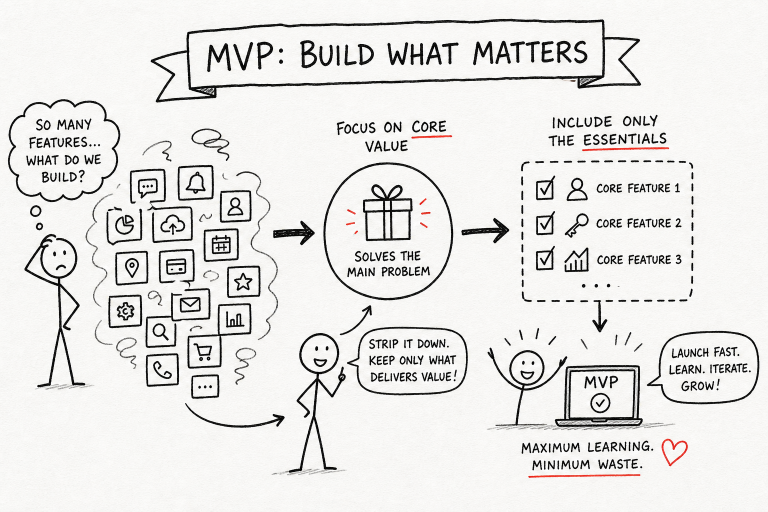
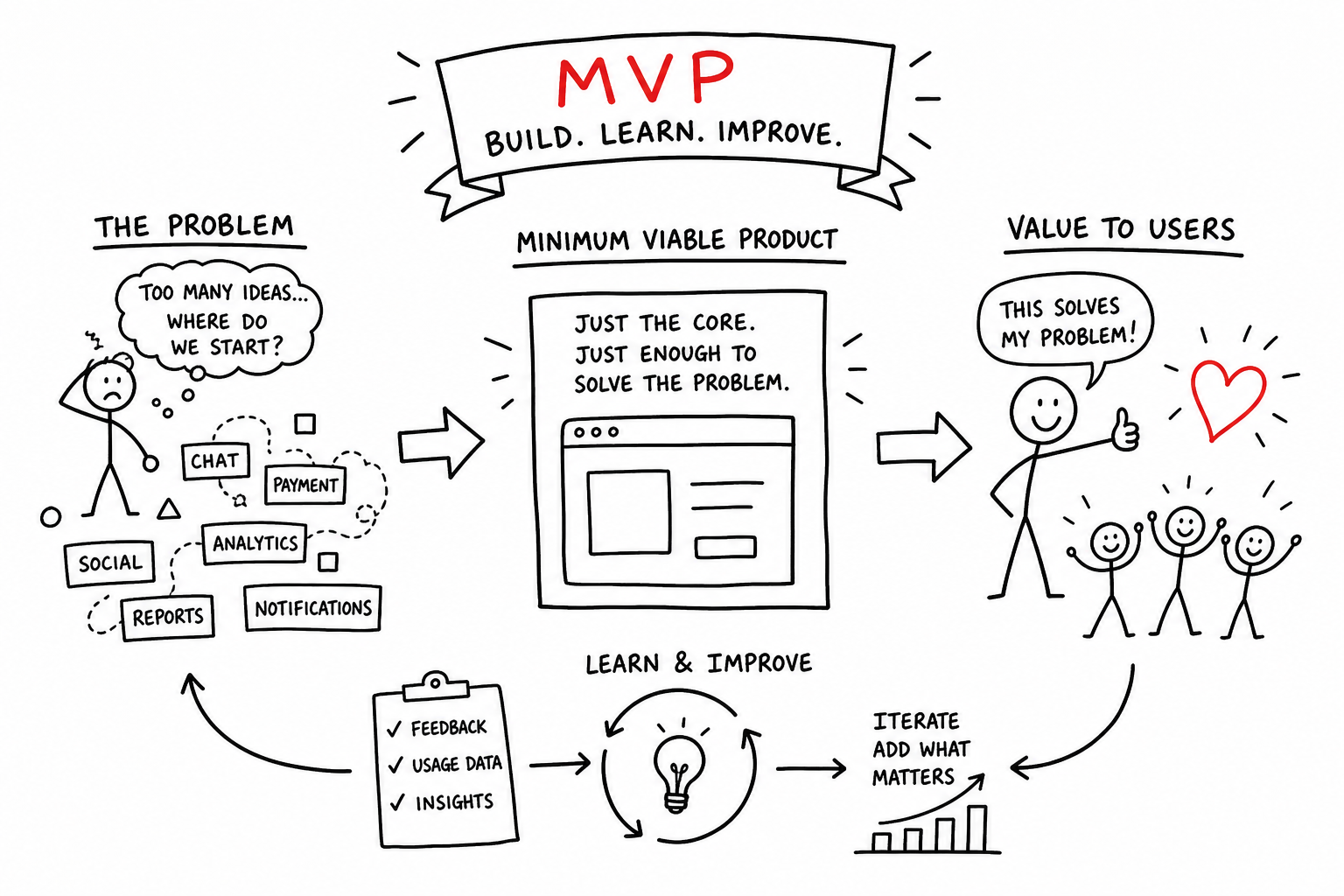
Eric Ries defined the minimum viable product as the version of a new product that allows a team to collect the maximum amount of validated learning about customers with the least effort. Read that sentence again carefully. The point is validated learning, not early revenue, not a soft launch, not getting something out the door. The MVP exists to test your most critical assumption: do real people experience this problem, and will they change their behavior to solve it? “Minimum” refers to minimizing wasted effort, not minimizing product quality.
A buggy, confusing product doesn’t test your hypothesis. It just teaches you that people don’t like bugs and confusion. The MVP should be lean, but it should be sharp. Every element that exists in it should exist for a reason tied directly to what you’re testing.
MVP vs. prototype vs. beta: the difference that matters financially
These three terms get used interchangeably by founders who then build the wrong thing entirely. A prototype tests a design concept. It shows how an interface might look and feel, usually without functional backend logic. An MVP in software development tests a business hypothesis with real users who experience a real version of your value proposition. A beta is a nearly complete product being refined and stress-tested before a full public launch.
Many founders who say they’re building an MVP are actually building a beta. They’ve already committed to the idea, they’re refining rather than testing, and they’re spending significantly more than a true MVP would cost. The difference isn’t semantic. It’s financial. Getting this definition right before you start is one of the highest-leverage decisions you’ll make in early product development.
The startup examples that prove less is more
The best way to internalize MVP development is to see how it played out in two of the most successful startups in recent history. Both cases involve founders who resisted the urge to build first, and both produced enormous validation with minimal investment.
Dropbox’s video that built a 75,000-person waitlist
Before Dropbox existed as a working product, founder Drew Houston faced a classic founder problem: reliable file sync across devices was technically hard to build, and he didn’t want to spend years solving it for a market that didn’t care. His solution was a three-minute demo video showing the product working as intended, even though the production-ready version didn’t exist yet. The video included inside jokes and Easter eggs aimed specifically at the early-adopter tech community on Digg.
The response was immediate. According to Drew Houston’s own account of the launch, the video drove the beta waitlist from 5,000 to 75,000 overnight. The MVP was not a product. It was proof that the market existed. Dropbox confirmed massive demand before writing a meaningful line of production code. This is the lean startup MVP philosophy in its purest form: test the hypothesis first, build the product second.
Airbnb’s manual booking process that skipped the app entirely
Airbnb’s founders didn’t build a platform to test their idea. They personally photographed apartments, manually matched guests with hosts, and processed bookings by hand. They stayed in hosts’ homes themselves to understand what guests and hosts actually needed. The entire operation ran on spreadsheets and elbow grease. This is often called a “Wizard of Oz” MVP: the experience looks like a product to the user, but a human is doing the work behind the curtain.
What the founders learned was that real money changed hands and real people had a good experience. They also discovered that the biggest barrier to adoption wasn’t technology, it was trust and listing quality. Poor photos were killing bookings, so they started taking better photos themselves. That insight drove real growth before a dollar went into platform engineering. As Paul Graham has noted, the best early-stage products often require doing things that don’t scale on purpose. Airbnb’s manual phase is the clearest proof of that.
Minimum viable product software development: scoping and validation
The instinct to add features is one of the strongest forces in product development. Every stakeholder has a favorite idea. Every user interview surfaces a new request. Without a disciplined scoping process, the MVP balloons into a full product before you’ve proven the core assumption.
Map the core user journey before touching a to-do list
Before any feature conversation happens, your job is to map the single user journey your MVP must support. Ask one question: what is the one thing a user needs to do to get value from this product? Everything else gets cut, at least for now. Story mapping is the best mental model for this: draw the user’s steps end to end, from first touch to core value delivered, then identify the smallest horizontal slice that creates a complete experience without any gaps.
This exercise is uncomfortable because it forces you to admit how little you actually need to build. That discomfort is productive. The goal is not to build everything your product could eventually do. The goal is to build the minimum thing that proves your most important assumption. A solid minimum viable product guide starts here, with the user journey, not the feature list.
Using MoSCoW to separate must-haves from wishlist items
MoSCoW stands for Must have, Should have, Could have, and Won’t have. It’s the simplest MVP feature prioritization tool available, and it works because it forces a conversation about necessity rather than preference. Must-haves are features the product fails without. Everything else belongs in the other three buckets.
Take a SaaS task management tool as a concrete example. “Create and assign tasks” is a Must. “Recurring reminders” is a Should. “Keyboard shortcuts” is a Could. “Dark mode” is a Won’t for v1. None of this is complicated, but without a framework like MoSCoW, dark mode ends up in sprint two because someone on the team cares about it. MVP feature prioritization is disciplined subtraction. You’re not deciding what to build, you’re deciding what to defer.
If you’d like a ready-to-use planning aid, the MoSCoW prioritization template can make those conversations concrete and visual for your team.
The validation methods that actually tell you something useful
Shipping the MVP is the beginning of the work, not the end. The whole point is to generate validated learning, which means methods and metrics need to be in place before launch, not after you notice something feels off.
The most useful validation toolkit for MVP development in software combines four approaches: user interviews, landing page smoke tests, usability sessions, and behavioral analytics. Interviews reveal whether the problem is real and how much it hurts. Smoke tests, where you drive traffic to a landing page before the product exists, reveal whether people will act on their stated interest. Usability sessions reveal whether users can actually complete the core task. Analytics reveal whether they come back after they do.
A solid validation approach uses at least two of these in combination. If you only run interviews, you’ll get enthusiastic feedback that doesn’t translate to real usage. If you only run analytics, you’ll see what happened but not why. The combination is where the insight lives. For practical testing approaches and checklists, Figma’s MVP testing methods resource offers useful patterns you can adapt to your context.
The most useful validation toolkit for MVP development in software combines four approaches: user interviews, landing page smoke tests, usability sessions, and behavioral analytics. Interviews reveal whether the problem is real and how much it hurts. Smoke tests, where you drive traffic to a landing page before the product exists, reveal whether people will act on their stated interest. Usability sessions reveal whether users can actually complete the core task. Analytics reveal whether they come back after they do.
Three metrics that tell you whether to iterate, scale, or pivot
Three signals carry most of the weight in MVP decision-making. Retention rate tells you whether users come back, which is the single strongest indicator of product-market fit. Based on benchmarks published by Lenny Rachitsky and other SaaS analysts, 40% or higher 90-day retention is generally considered a strong signal that growth investment is warranted, while anything below 20% suggests a fundamental problem worth investigating before adding more users to the funnel, though the right threshold varies by category, with B2B and marketplace products often benchmarking differently than consumer apps. Task completion rate tells you whether users can do the core thing your MVP promises. Conversion rate tells you whether they take the desired action; industry benchmarks from sources like OpenView’s annual SaaS surveys place healthy trial-to-paid conversion in the 15% to 25% range for many SaaS products, with the caveat that this varies significantly by price point and sales model.
The decision rule is straightforward. Strong retention signals you’re onto something worth scaling. Weak retention with decent conversion usually points to an onboarding or experience problem worth iterating on. No retention and no conversion is the pivot signal. The product isn’t solving a problem people care enough about to return for.
What it actually costs to build an MVP in 2026
Budget conversations make founders uncomfortable because the numbers vary so widely depending on who you ask. Before looking at the ranges, it’s worth noting that scope discipline is the single biggest variable in what you actually spend. The most expensive MVPs are rarely the most technically complex, they’re the ones where “minimum” got negotiated away feature by feature. Here’s a grounded breakdown based on current development costs, organized by product type and approach.
Timeline reality check by product type
A no-code or low-code MVP can move from idea to launch in four to eight weeks. A custom-built web or SaaS MVP with a lean scope typically takes two to six months. Mobile-first builds or products with complex integrations often push six to twelve months. The real driver of timeline isn’t team speed, it’s scope. Every feature you add extends the timeline, which is the most concrete argument for MVP discipline you’ll find. These ranges reflect lean, well-scoped builds; actual timelines depend heavily on team composition and integration requirements.
Cost ranges and what pushes the number up
In 2026, no-code MVPs run roughly $5,000 to $15,000. Simple custom builds land between $15,000 and $55,000. Standard SaaS products typically fall in the $55,000 to $140,000 range. These figures reflect current market rates and will shift based on region, compliance requirements, and integration complexity. The biggest cost drivers are scope creep, integrations, design quality, and team location. Offshore development teams in Eastern Europe, Latin America, or Southeast Asia can reduce costs materially compared with North American rates.
If you want an external cost reference, a recent breakdown of industry estimates explains how much it costs to build an MVP and the factors that push estimates up or down.
The most important cost insight is this: maintaining strict MVP scope discipline can materially reduce development cost compared with a build that lets scope creep in. The MoSCoW framework from the previous section isn’t just a planning tool. It’s a budget tool. Every feature that moves from Must to Won’t is real money staying in your pocket until you’ve proven the core product works.
The mistakes that kill MVPs before they prove anything
Most MVP failures trace back to one of two root causes: building before validating, or ignoring what users actually do. Both are fixable with the right habits in place before development starts.
Building before validating (one of the most costly mistakes in early-stage startups)
The classic failure mode is a team that spends months building before confirming the problem is real. They have conviction in the idea, they hire developers, and they move fast in the wrong direction. The remedy is front-loading discovery. Run ten user interviews before writing code. Build a landing page and measure sign-up intent. The product should start only after the problem has been confirmed with real evidence, not with founder assumptions dressed up as market research.
The Dropbox example is instructive here: Houston validated demand with a video before the product existed. He didn’t assume demand was real because the problem felt obvious to him. He tested it. That discipline is what separates founders who iterate toward product-market fit from founders who run out of runway before they get there.
Ignoring what users actually do versus what they say
Users will tell you your product is great in interviews and then never open it again. This isn’t dishonesty, it’s the natural gap between stated preference and actual behavior. Verbal feedback captures what people think they want in the moment. Behavioral analytics capture what they actually do with the product over time. Session recordings, funnel drop-off data, and feature usage reports tell the honest story that user interviews can’t.
Founders who rely only on qualitative feedback miss the most important signals their MVP is sending. For example, if the majority of users drop off before completing the core task, no amount of positive interview feedback changes that reality. Instrument your MVP before launch, review the data weekly, and treat behavioral signals as the primary input for your next iteration decision.
Build the smallest thing that proves the biggest assumption
Minimum viable product software development isn’t about shipping fast and shipping rough. It’s about building the smallest possible thing that tests your most important assumption before you over-invest in the wrong direction. Dropbox did it with a three-minute video. Airbnb did it with personal photos, manual bookings, and spreadsheets. The framework works precisely because it forces clarity about what you’re actually trying to prove, and it protects you from the very human urge to keep building before you’ve confirmed the market exists.
Between story mapping, the MoSCoW framework, and the validation metrics above, the scope decisions largely make themselves. The process of minimum viable product development isn’t complicated. The hard part is the discipline to stop adding features and start collecting evidence. For a strategic overview of prioritization methods and concrete MVP examples, see this strategic guide to MVP feature prioritization that outlines frameworks you can adapt to your product context.
If you want more startup frameworks broken down this way, with real company examples and zero academic fluff, CasualMBA publishes exactly this kind of content every week. It’s the business education that actually sticks, explained the way a smart friend would explain it. Check out the rest of the blog and subscribe to the weekly newsletter to keep building your strategic toolkit one concept at a time.