Behavioral Economics Pricing: Why You Pay What You Pay
You open Netflix’s pricing page planning to pick the cheapest plan. Thirty seconds later, you’ve chosen the middle one. Nobody twisted your arm. The page just made it feel like the obvious, sensible choice. That’s not a coincidence. It’s behavioral economics pricing at work, and it’s the quiet engine behind nearly every major brand’s revenue strategy.
This is exactly the kind of business mechanic we break down at CasualMBA: real companies, real psychology, zero textbook jargon. In this article, you’ll learn three core tactics that move the most money, anchoring, the decoy effect, and loss aversion, with examples from Apple, Netflix, and Amazon. You’ll also get a practical experiment framework so you can test these ideas in your own pricing next week.
Why Rational Pricing Is a Myth
Classic economics assumes buyers do math. They evaluate a product’s value, compare it to the price, and make a logical call. Behavioral economics, the field Daniel Kahneman and Richard Thaler built their careers on, shows that’s almost never how it works. People don’t evaluate prices in isolation. They compare them to reference points: what they paid before, what a competitor charges, or simply whatever number they saw first on the page.
That first number is called a reference price, and it acts as the buyer’s mental baseline. When a price lands above their reference point, it feels expensive. Below it, it feels like a deal. The gap between actual value and perceived value is where behavioral pricing lives. Brands that understand this stop competing on price alone and start competing on how the price is perceived. That’s a very different game, and one you can play regardless of your budget or company size.
Behavioral Economics Pricing Tactic #1: Anchoring
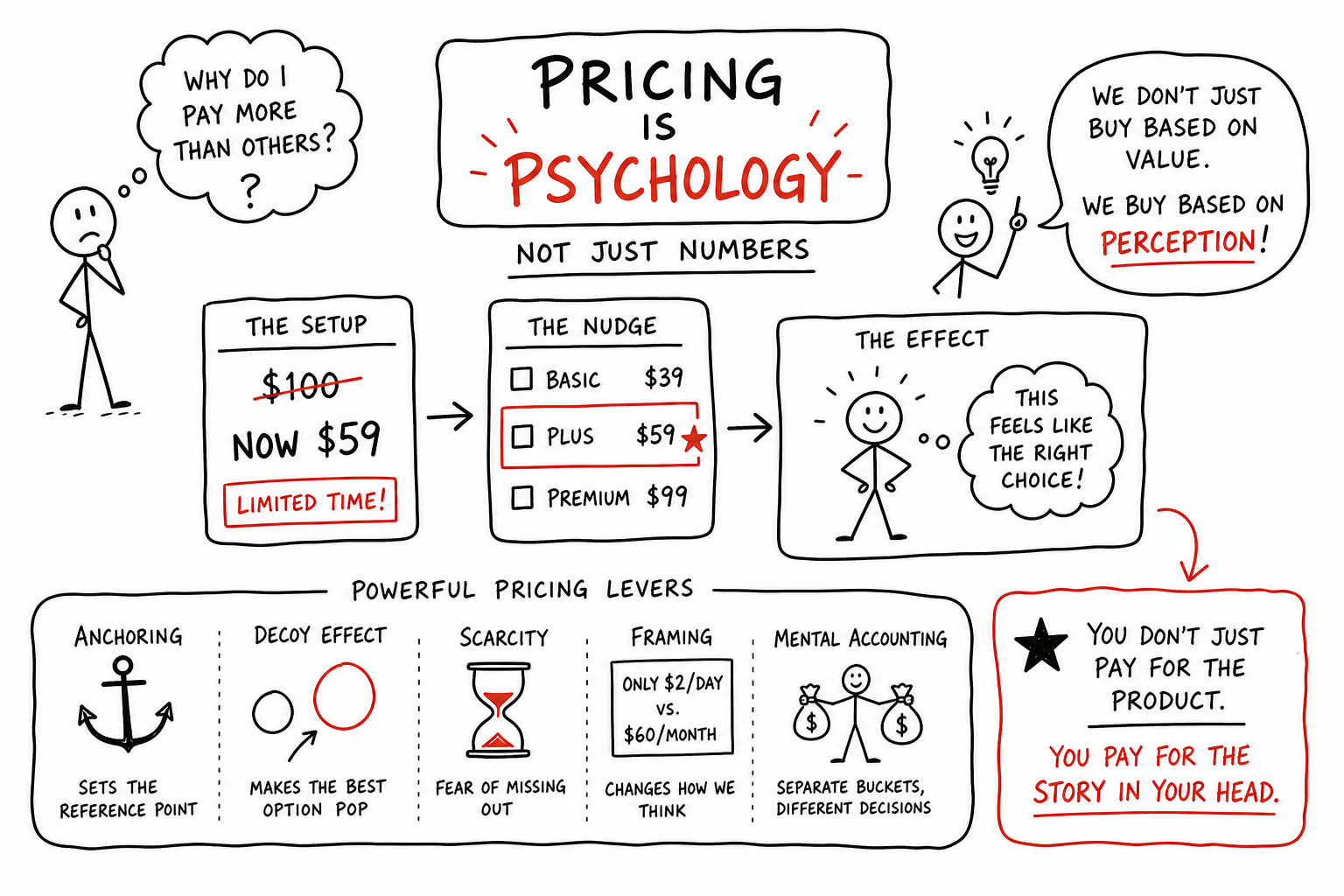
Apple doesn’t lead with the cheapest iPhone. It leads with the flagship, often priced at $1,199 or more, and then presents a $999 model that suddenly feels accessible by comparison. That contrast is deliberate. The high anchor pulls the buyer’s reference point upward, making the mid-tier option look like value rather than compromise. Apple has used this move repeatedly: at the iPad launch, the audience was primed to expect $999, then the actual $499 price landed as a relief. The Pro Display XDR launch cited a $43,000 Sony reference monitor before revealing Apple’s price, dragging expectations skyward before the reveal.
The empirical evidence backs this up. A multi-store field study found that unit-price anchoring produced 32% more sales than single-price anchoring across 13 products in 43 real stores. Separately, research on choice experiments found anchoring increased estimated willingness to pay by roughly 44% to 51% when the price vector was doubled. These aren’t small effects. The mechanism is straightforward: show a higher price first, and every subsequent price looks better, even if it’s the only price you ever planned to charge. For a practical breakdown of how to apply this in your pricing, see Master the Price Anchoring Effect for Revenue Growth.
There’s one important guardrail. If your anchor is too far from the buyer’s reality, it reads as manipulative rather than helpful. An anchor of $10,000 for a $99 product doesn’t make $99 feel cheap, it makes the whole offer feel shady. Keep your anchors in a believable range and tie them to real feature or tier differences. The anchor has to be credible to work.
Behavioral Economics Pricing Tactic #2: The Decoy Effect
Netflix structures its plans so the middle tier almost always wins. The cheapest plan has enough restrictions to feel limiting. The most expensive plan has features most subscribers don’t need. The middle plan hits a sweet spot that the pricing architecture was specifically designed to highlight. This is the decoy effect: introducing a less attractive option, whether an overpriced premium tier or an under-featured basic tier, to make your target option look like the obvious, sensible pick. It works because it simplifies a hard decision. Instead of asking “is this worth it?”, the buyer asks “which of these is better?”, and the answer is already built into the design.
The concept connects directly to choice architecture, the idea that how options are arranged shapes which one gets chosen. When buyers face two options, the decision is genuinely harder and walk-away rates go up. Add a third option that’s slightly inferior to your preferred choice, and something interesting happens: the inferior option doesn’t cannibalize your target. It reinforces it. In documented pricing experiments, introducing a premium anchor has been shown to increase conversions to a mid-tier plan by roughly 20, 40%, depending on the product and audience. That principle travels beyond subscription pricing into product bundles, service packages, and event ticketing. Any time you present multiple options, you’re doing choice architecture, whether you realize it or not.
Behavioral Economics Pricing Tactic #3: Loss Aversion
Kahneman’s most replicated finding is that people feel the pain of a loss roughly twice as intensely as the pleasure of an equivalent gain. Amazon Prime uses this constantly, and the framing is subtle. It’s not “enjoy free shipping on every order.” It’s “don’t pay $5.99 shipping on this item.” The checkout page makes the cost of not having Prime visible and immediate. That shift in emphasis, from what you’d gain to what you’d lose, activates a stronger mental lever. The transaction feels less like buying something and more like avoiding a penalty.
You can apply the same logic to your own pricing without changing your actual offer at all. Compare these two framings for the same upgrade prompt: “Get 20% more storage” versus “You’re running out of storage on your current plan.” Same reality, different psychology. Or consider: “Upgrade for advanced analytics” versus “You’re missing campaign data your competitors can see.” In most A/B pricing tests, loss-framed versions outperform gain-framed ones, a pattern observed consistently across e-commerce, SaaS, and subscription businesses. For a concise primer on why customers react to price increases and loss framing, see loss aversion in pricing. The ethical line is worth noting here. Describing a genuine trade-off in loss terms is fair and effective. Inventing fake scarcity or manufactured deadlines is manipulation, and it destroys long-term trust faster than any short-term conversion gain is worth.
How to Test Behavioral Economics Pricing in Your Own Business
Here’s a practical experiment framework you can run whether you’re operating a SaaS product, an e-commerce store, or a service business. It doesn’t require a pricing team or a research budget, just a clear process. If you need a reference for common SaaS pricing models and how they map to experimentation, check this guide to SaaS pricing models.
Start with a specific hypothesis before you touch anything. “Showing the annual plan before the monthly plan will increase paid conversion by 15% over two billing cycles” is a testable hypothesis. “Let’s try some pricing stuff” is not. Then change one variable at a time: price level, billing cadence, tier structure, or how the offer is framed. Randomly split your traffic between the control and the variant, and run the test for at least two full billing cycles. This part matters more than most people realize. Pricing tests that only run for two weeks capture first-purchase behavior, not retention, and a pricing change that boosts signups while tanking 30-day retention is a losing trade. For practical A/B test ideas and statistical considerations specific to pricing, see A/B testing pricing tips.
Testing Behavioral Pricing: What to Measure
On the measurement side, your primary metric should be revenue per visitor, not conversion rate alone. A lower price can inflate signups while tanking total revenue, and you won’t see that if you’re only watching conversion. Secondary metrics to track include:
- Trial-to-paid conversion rate
- Churn rate at 30 and 90 days
- Average revenue per user (ARPU)
- Support ticket volume and refund requests (your early warning system)
Support tickets and refund requests are guardrail metrics. If they spike after a pricing change, the tactic is eroding trust rather than building it, and you need to know that before it compounds. Behavioral economics pricing isn’t a one-time fix you ship and forget. It’s a feedback loop you run continuously, adjusting as your product, audience, and market evolve.
Pricing Is Psychology With a Number Attached
Anchoring, the decoy effect, and loss aversion are three price framing tactics that move serious money without requiring a cheaper product or a bigger ad budget. They work because they meet buyers where they actually are: making decisions based on context, framing, and reference points rather than objective value calculations. Apple’s lineup structure, Netflix’s tier design, and Amazon’s checkout framing all run on the same underlying logic.
Once you know what to look for, you see it everywhere. And the good news is that none of this requires a Fortune 500 pricing team or an academic research budget. A clear hypothesis, one variable, two billing cycles of data, and the right metrics to track, that’s the whole playbook. Start with the tactic most relevant to your current pricing page and run the experiment.
Behavioral economics pricing shows how anchoring, decoy effects, and loss aversion change buyer behavior, and how you can test them without guesswork. If this kind of real-world business breakdown is useful to you, it’s exactly what CasualMBA covers every week: taking frameworks that get taught in business school and showing how they actually work inside companies you already follow. The concepts are the same. The jargon is gone.