
What Is a Co-Founder — and Does Your Startup Actually Need One?
Every startup article, every investor pitch guide, and every accelerator application form assumes you have a co-founder. Y Combinator famously prefers founding teams over solo founders. First-time entrepreneurs are routinely told that going alone is a mistake.
But is it actually true that every startup needs a co-founder? Or is this one of those pieces of conventional wisdom that deserves a harder look?
The honest answer is that it depends entirely on what you are building, what you are missing, and whether the person you are considering is genuinely a co-founder or just someone you are giving equity to because the advice said you should.
What a co-founder actually is
A co-founder is not a business partner in the traditional sense. It is not someone who invests money and gets a share of the business. It is not an early employee who joins before the company has revenue. And definitely it is not a friend who helps out in the beginning.
A co-founder is someone who takes on the founding risk with you. Who gives up the same certainty you gave up, bets the same years of their life on the same uncertain outcome. Who shares the equal ownership of the vision from the very beginning.
The key word is risk. A co-founder is defined not by their role or their skills but by what they are willing to lose if it does not work. That shared downside is what separates a co-founder from everyone else who touches an early stage startup.
This distinction matters because many early stage founders make the mistake of calling the first person who joins them a co-founder when they are really an early employee . And then discovering that the equity split, the expectations, and the decision-making dynamics that come with co-founder status create serious problems later.
The real reasons to have a co-founder
There are three genuinely good reasons to bring on a co-founder — and none of them are simply “to share the work.”
The first is complementary skills. The most successful founding teams in history have almost always combined distinct and complementary capabilities. Steve Jobs brought vision, taste, and the ability to sell. Steve Wozniak built the actual product. Neither could have built Apple alone — not because the work was too much for one person but because the specific combination of skills required to build both a great product and a great company around it genuinely needed two different kinds of people.
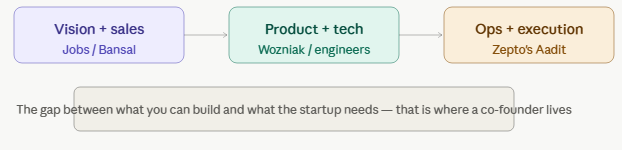
Sachin Bansal and Binny Bansal at Flipkart built a similar complementary dynamic. The founding team of Zepto — Aadit Palicha and Kaivalya Vohra — combined operational intensity with technical depth in a way that neither likely could have replicated alone at 19 years old.
If there is a genuine skill gap at the core of what your startup needs to work — not a gap you can hire for, but a gap in the founding vision itself — a co-founder who fills that gap is genuinely valuable.
The second reason is accountability. Building a startup is one of the most psychologically difficult things a person can do. There are weeks where everything feels broken, investors say no, users churn, and the entire premise of the company feels wrong. Having someone who is equally invested — who cannot simply quit without losing as much as you — creates a forcing function for persistence that solo founders have to manufacture entirely from internal motivation.
The third reason is decision-making. The hardest decisions a startup makes are almost never clear-cut. Having a co-founder means having someone who knows the company as deeply as you do and can pressure-test your thinking before you commit. Not an advisor who gives polished advice from the outside — someone who will be equally affected by whether the decision is right or wrong.
The real reasons not to have one
The conventional wisdom that every startup needs a co-founder ignores an equally important set of truths.
Sridhar Vembu built Zoho, one of India’s most successful software companies. The company generates over $1 billion in revenue. He did it largely alone, without venture capital or a high-profile co-founder. He also built it without the startup ecosystem validation that many founders seek. Today, Zoho is private, profitable, and the result of a vision executed over decades.
A bad co-founder is often worse than no co-founder at all. Founder conflict is a leading cause of startup failure because equal partners can deadlock on strategy, culture, priorities, or values. When neither founder can break the tie, progress stalls. Snapchat faced this issue early when co-founder Reggie Brown sued Evan Spiegel, leading to a $157 million settlement. Equity disputes between co-founders are costly, distracting, and can destroy an otherwise viable business.
If you are considering bringing someone on as a co-founder primarily because you are told you should, think carefully. A co-founder should fill a genuine skill gap. They should also share your vision and have the same appetite for risk. Otherwise, you may be creating a future problem in exchange for present comfort.
How to find a co-founder if you need one
If you have genuinely identified that a co-founder would make your startup stronger, finding the right one is worth treating as seriously as any other foundational decision.
The best co-founders almost always come from existing relationships — people you have worked with, studied with, or built something with before. The reason is simple: co-founder compatibility under startup pressure is nearly impossible to evaluate in a short time. Working with someone on a real project, even a small one, reveals how they handle stress, disagreement, and ambiguity far better than any number of conversations.
For those who do not have an obvious candidate in their existing network, communities like YourStory’s founder network, LinkedIn startup communities, startup weekends, and accelerator programs like Antler India exist specifically to facilitate co-founder matching. Antler in particular runs a structured program designed to help founders find and evaluate co-founders before committing.
The process should feel less like hiring and more like deciding to climb a mountain with someone. You want to know how they behave when things go wrong — not just how excited they are about the summit.
The equity question
One of the most practically important co-founder decisions is equity split — and the most common mistake is getting it wrong early and discovering the consequences late.
Equal splits — 50/50 — are clean and signal mutual commitment. They also create deadlock risk when founders disagree on major decisions. Many successful founding teams have used equal splits effectively by building strong decision-making frameworks and trust before the equity became contentious.
Unequal equity splits can reflect differences in contribution. However, they may create resentment if the junior co-founder feels undervalued as the company grows. A 60/40 or 70/30 split can work well when the reasoning is clear. In many cases, this is healthier than a forced 50/50 split that does not reflect reality.
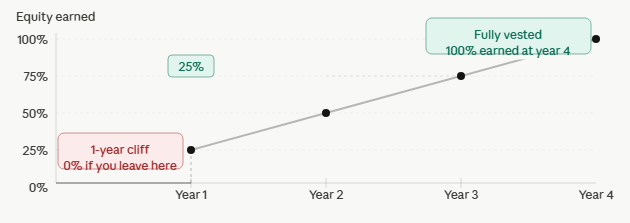
What matters more than the exact split is the vesting schedule. Standard startup vesting is four years with a one-year cliff — meaning a co-founder who leaves in the first year gets nothing, and one who stays earns their equity gradually over four years. This protects the company from a co-founder who joins enthusiastically and leaves after six months with a large equity stake.
So does your startup actually need a co-founder?
If you have a genuine skill gap at the core of your startup, a co-founder may make sense. The gap should be something that cannot simply be solved by hiring. You should also have a specific person in mind who shares your vision and appetite for risk. Ideally, you should already have a track record of working well together under pressure. If those conditions are met, bring them in as a co-founder.
If you are looking for someone to share the workload, provide emotional support, or satisfy an investor’s preference for teams — those are real needs, but they do not require giving away half your company. They require good early hires, good advisors, and honest self-awareness about what you actually need.
The best co-founder relationship looks like Sachin and Binny Bansal — two people with complementary strengths building something neither could have built alone. The worst looks like a 50/50 split with someone you liked in the beginning and cannot agree with about anything that matters.
The decision deserves more thought than most first-time founders give it.
Understanding business means understanding that every founding decision compounds — and equity decisions compound the most.
Startup takeaway:
“A co-founder is not someone to share the work with. They are someone to share the risk with — and that is a completely different standard.”