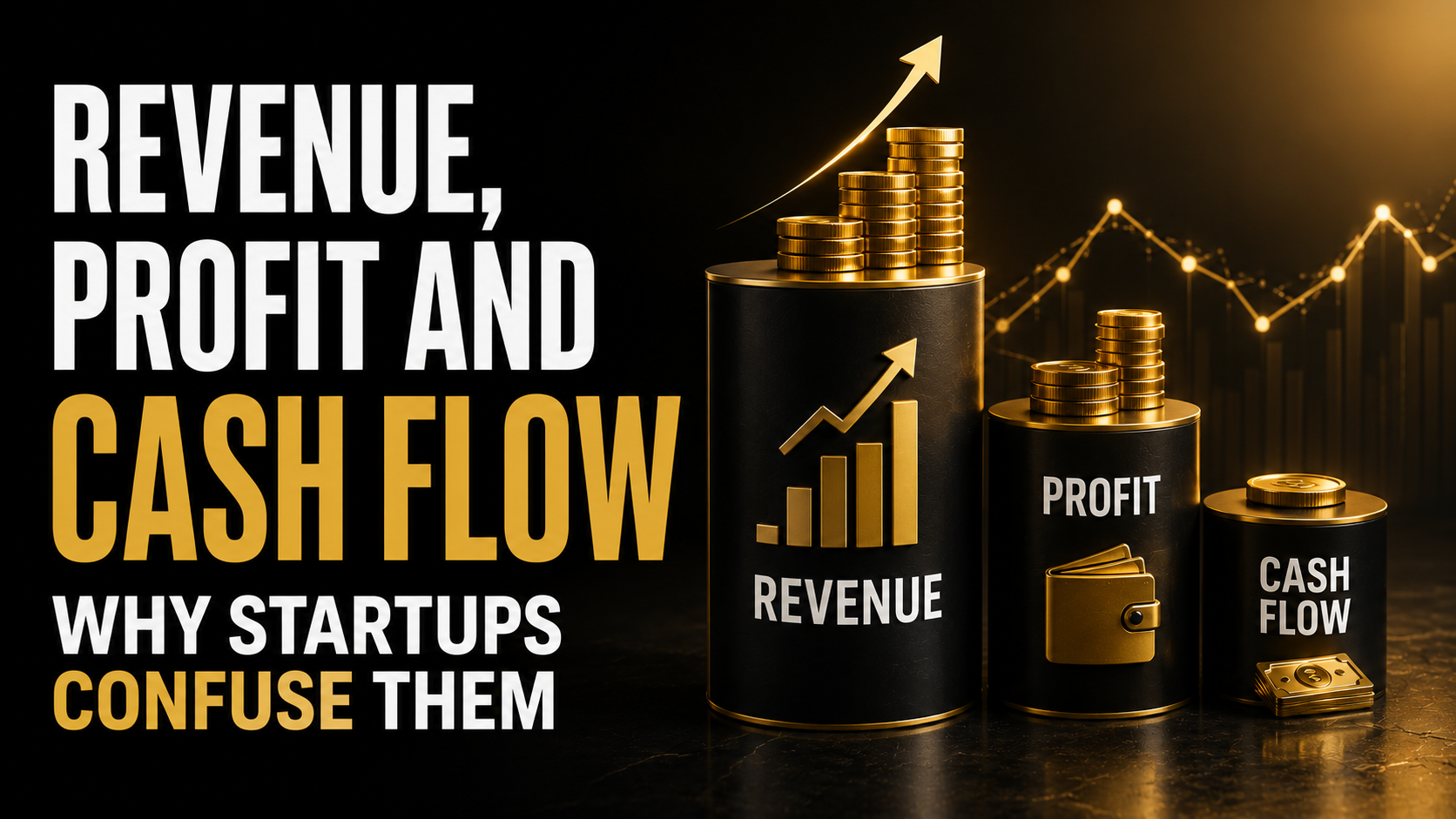
Revenue, Profit and Cash Flow — Why Startups Confuse Them
Every startup founder celebrates when revenue grows. Investors ask about it. Headlines announce it. Press releases lead with it.
But revenue alone tells you almost nothing about whether a business is healthy. Understanding the difference between revenue, profit and cash flow is one of the most important things any founder or startup enthusiast can learn — and one of the most consistently misunderstood.
Zomato reported revenues of over ₹7,000 crore and still posted significant losses. WeWork generated billions of dollars in revenue and nearly bankrupted itself. These are not contradictions. They are what happens when you confuse three very different numbers.
The chai stall that explains everything
Before getting into startups, consider a simple chai stall.
The stall owner sells 100 cups of chai at ₹20 each. That is ₹2,000 in revenue — the total money coming in from customers.
But making those 100 cups cost ₹800 in milk, tea, sugar and gas. After subtracting those costs, the owner has ₹1,200 left. That is the profit — what remains after paying the direct costs of running the business.
Now here is where cash flow enters. The stall owner borrowed ₹5,000 last month to buy a new stove. That loan repayment of ₹500 is due today. After paying it, the owner has ₹700 in hand.
Revenue was ₹2,000. Profit was ₹1,200. Cash in hand at the end of the day was ₹700.

Three different numbers. Three different stories about the same business.
What revenue actually tells you
Revenue is the total money a business brings in from selling its product or service before any costs are deducted. It is the top line — the starting point, not the destination.
High revenue means the business is doing a lot of transactions. It means customers exist and are paying for something. That is genuinely meaningful, especially for early stage startups trying to prove demand.
But revenue says nothing about whether the business is sustainable. A company can grow revenue aggressively by pricing below cost — essentially paying customers to use the product. Many Indian startups did exactly this during the deep discounting era of food delivery and e-commerce. Revenue was soaring. The underlying economics were broken.
This is why revenue without context is a vanity metric. It tells you the business is active. It does not tell you the business is working.
What profit actually tells you
Profit is what remains after subtracting costs from revenue. But even this is more nuanced than it sounds because there are different kinds of profit that tell different stories.
Gross profit subtracts only the direct costs of delivering the product — the ingredients in the chai, the packaging, the delivery cost per order. Gross profit tells you whether the core product itself is economically viable.
Operating profit subtracts all the costs of running the business — salaries, rent, marketing, technology. Operating profit tells you whether the business as a whole is viable before accounting for debt or taxes.
Net profit is what remains after everything including taxes and interest. This is the number most people mean when they say “profit.”
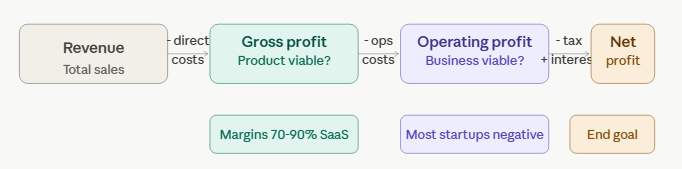
A startup can have healthy gross profit and negative operating profit — meaning the product itself works, but the cost of building the organisation around it is currently too high. This is actually the situation most high-growth startups are in deliberately. As we explored when looking at what a business model actually is, the economics of a business are a designed system — and sometimes the design intentionally delays profit in favour of growth.
What cash flow actually tells you
Cash flow is the movement of actual money in and out of the business — and it is the number that determines whether a startup survives in the short term, regardless of what the revenue or profit figures say.
Here is why profit and cash flow diverge. A startup might sign a large annual contract worth ₹1.2 crore. On paper that shows as revenue and profit. But if the customer pays quarterly, the startup only receives ₹30 lakh in the first month. Meanwhile salaries, servers and marketing bills are due right now. The business is profitable on paper and cash-strapped in reality.

This gap between profit on paper and cash in the bank has killed businesses that looked perfectly healthy from the outside. According to CB Insights research on startup failure, running out of cash is consistently one of the top reasons startups fail — not because they had no revenue or no profit, but because cash timing broke down.
Why profitable businesses still go bankrupt
One of the strangest things in business is that a company can technically be profitable and still die.
This sounds impossible until you understand timing.
Imagine a startup sells software subscriptions worth ₹1 crore annually. On paper, that revenue may make the company look healthy. But if customers pay slowly while salaries, servers and office expenses must be paid immediately, the company can run out of cash despite showing profit in its financial statements.
This is why cash flow problems destroy businesses that look successful from the outside.
A famous example is Kingfisher Airlines. The airline generated enormous revenue and built a premium brand image, but the business constantly struggled with debt obligations and cash shortages. Revenue existed. Customers existed. But the cash flow structure became unsustainable.
This is also why experienced investors often say:
“Revenue is opinion. Cash is reality.”
A startup survives on actual cash movement, not screenshots of growth metrics or valuation headlines.
Many founders obsess over:
- downloads
- users
- revenue charts
while ignoring the one thing that determines survival:
how long the company can continue operating before the bank account reaches zero.
Why startups burn cash intentionally
Understanding cash flow also explains something that confuses most people about Indian startups — why companies like Zepto and Swiggy spent years burning hundreds of crores and still attracted massive investment.
Burning cash is not always mismanagement. For certain types of businesses, especially marketplace and platform models, the strategy is to acquire users and build habits at scale before optimising for profit. The underlying logic is that once you have dominant market position and strong retention — which we covered in detail when examining what product market fit actually means — you can then raise prices, cut subsidies and move toward profitability.
This is sometimes called the blitzscaling strategy, a term popularised by Reid Hoffman, LinkedIn’s co-founder. The idea is that in winner-take-most markets, speed of growth matters more than immediate profitability. Lose the land grab and you may never recover market position.
The risk is obvious — this strategy only works if you reach dominance before running out of cash. WeWork is the cautionary tale. The company burned cash at extraordinary scale, built massive revenue, and still collapsed because the unit economics were fundamentally broken and the cash burn was unsustainable regardless of growth rate.
The number founders actually need to watch
Revenue tells you whether customers want what you are selling. Profit tells you whether the business can be sustainable. Cash flow tells you whether you will survive long enough to find out.
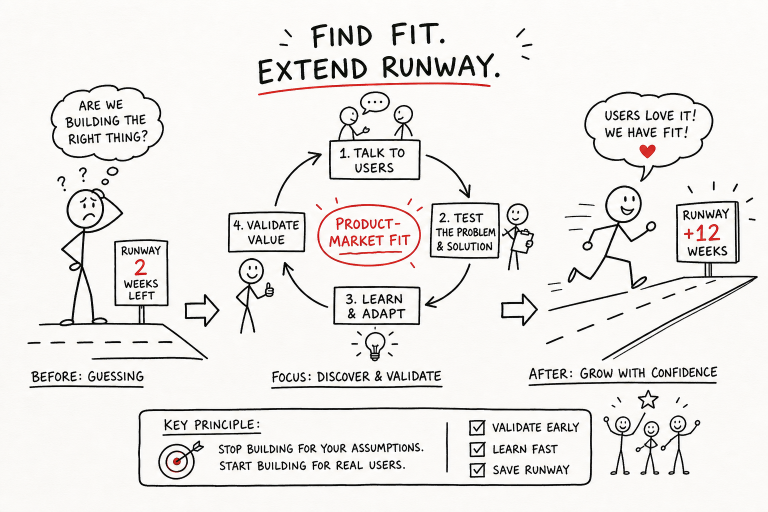
For early stage founders, the most important number is often not revenue or profit but runway — how many months of cash does the business have left at the current burn rate. Runway is calculated simply: cash in the bank divided by monthly net cash outflow.
A startup with ₹50 lakh in the bank burning ₹5 lakh per month has ten months of runway. That is ten months to find product market fit, raise more capital or reach profitability. Understanding that number — and making decisions that extend it — is more valuable in the early stages than chasing revenue growth for its own sake.
Reading startup news differently
Once you understand the difference between revenue, profit and cash flow, you start reading startup news completely differently.
When a startup announces record revenue, the right question is what the margins look like. When a startup announces it is profitable, the right question is whether it is generating positive cash flow or just accounting profit. When a startup raises a large funding round, the right question is how long that runway extends and what milestones the company needs to hit before it runs out.
These are not cynical questions. They are the questions that separate people who understand business from people who only read headlines.
Revenue, profit and cash flow each tell part of the story. No single number tells the whole story. A founder or investor who understands all three — and the relationship between them — sees businesses clearly. Everyone else is reading the highlights and missing the game.
Understanding business means reading the numbers behind the numbers.
Startup takeaway:
“Revenue is applause. Profit is the score. Cash flow is whether the lights stay on.”
Ready to test your understanding? Download the free Semester 1 Worksheet and apply every concept to a startup you know.