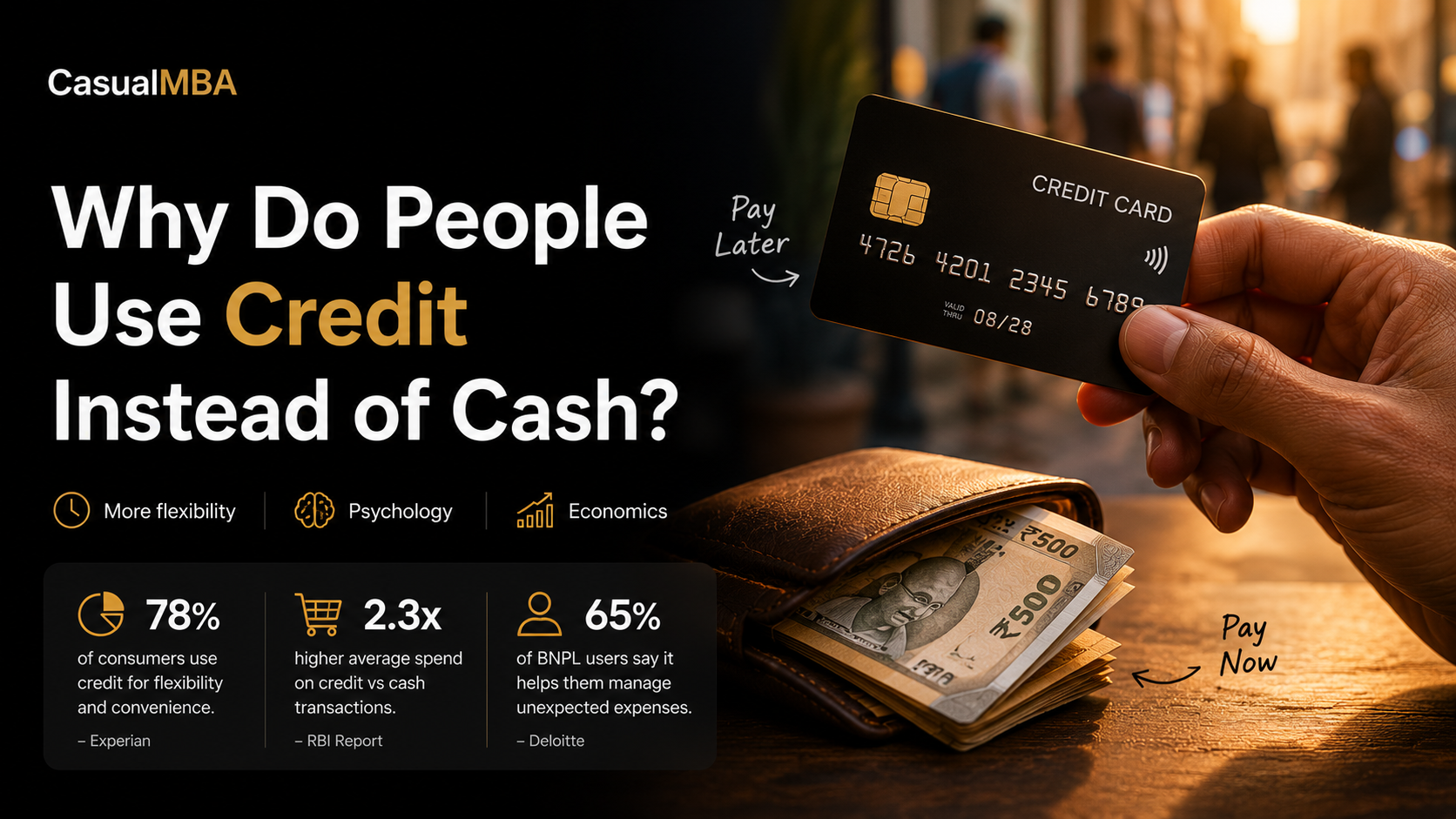
Why Do People Sometimes Use Credit Instead of Just Using Cash?
At first glance, using credit sounds irrational.
Why would someone willingly spend money they don’t currently have, especially when cash already exists?
Yet credit powers a massive part of the global economy. People use credit cards to buy:
- phones
- flights
- groceries
- luxury products
- subscriptions
- even coffee
And companies actively encourage it.
Banks offer reward points. E-commerce apps promote “Buy Now, Pay Later.” Credit card companies market lifestyle, travel, and exclusivity instead of debt.
Clearly, something deeper is happening here.
Because credit is not just a payment method anymore. It’s become a psychological and economic tool.
Credit Reduces Immediate Pain
One of the biggest reasons people use credit is surprisingly simple:
it delays financial discomfort.
When you pay cash, the loss feels immediate. You physically see money leaving your wallet or bank account.
Credit softens that experience.
Psychologists have studied something called the “pain of paying.” Research has consistently shown that people tend to spend more when using cards instead of physical cash because digital payments feel less emotionally painful.
That’s why restaurants, apps, streaming services, and online stores prefer frictionless payment systems. The easier the payment feels, the less resistance customers experience.
In many ways, credit disconnects consumption from consequence — at least temporarily.
Credit Sells Time
Modern economies increasingly operate around future income.
Many people use credit not because they are irresponsible, but because they expect future earnings to cover present spending.
A student may buy a laptop on EMI because waiting two years to save cash would delay their work or education.
A business may take loans to grow faster instead of waiting slowly for profits.
A family may finance a vehicle because transportation immediately improves earning opportunities.
Credit essentially allows people to pull future purchasing power into the present.
That’s why economies rely heavily on it. Without credit, growth would often slow dramatically because fewer people could afford large purchases upfront.
Businesses Love Credit Because Spending Increases
Credit systems benefit businesses enormously.
Studies across retail and e-commerce consistently show that customers spend more when paying digitally or through credit compared to cash purchases.
Why?
Because credit changes perception.
₹50,000 paid immediately feels heavy.
₹4,200 per month for 12 months feels manageable.
Even when mathematically the total cost becomes higher due to interest, the smaller monthly framing feels psychologically safer.
This is one reason why EMIs became so dominant in industries like:
- smartphones
- electronics
- automobiles
- luxury products
Businesses realized that affordability is often about perception, not just actual price.
Credit Also Became a Status Signal
Credit cards today are not only financial tools. They’re branding products.
Premium cards advertise:
- airport lounge access
- luxury dining
- cashback
- travel rewards
- exclusivity
Some cards are designed to make users feel financially successful even before they truly become wealthy.
That emotional positioning matters.
Financial companies learned long ago that consumers are not purely rational. Spending decisions are often connected to:
- identity
- aspiration
- lifestyle
- social image
That’s why credit companies market experiences far more than debt itself.
The Internet Accelerated Credit Culture
Digital commerce changed how frequently people spend money.
Earlier, buying something required effort:
- visiting stores
- carrying cash
- physically deciding
Now purchases happen in seconds.
Combined with one-click payments, saved cards, and Buy Now Pay Later systems, the internet dramatically reduced the friction around spending.
This created a culture where consumption became faster than financial reflection.
Some apps are intentionally designed to minimize hesitation during checkout because every extra second of thinking reduces conversion rates.
The smoother the payment experience becomes, the more spending tends to increase.
Credit Is Not Always Bad
Credit often gets framed negatively, but the reality is more nuanced.
Used responsibly, credit can:
- improve liquidity
- help build businesses
- enable education
- manage emergencies
- improve purchasing flexibility
Entire companies and economies depend on borrowing to expand.
The issue usually begins when consumption grows faster than repayment ability.
Credit becomes dangerous when it stops funding:
- productivity
- growth
- necessity
and starts funding unsustainable lifestyle inflation.
That’s when debt transforms from a tool into a trap.
Why Humans Naturally Gravitate Toward Credit
At a deeper level, credit appeals to human psychology because people naturally prioritize the present over the future.
Behavioral economists call this “present bias.”
Humans consistently value:
- immediate comfort
- instant gratification
- short-term pleasure
more strongly than distant consequences.
That’s why:
- saving feels difficult
- impulse buying feels easy
- future debt often feels abstract
Credit systems work effectively because they align perfectly with this human tendency.
So Why Do People Use Credit Instead of Cash?
Because credit changes how spending feels.
It reduces immediate pain, increases purchasing power, delays financial pressure, and creates psychological flexibility.
For businesses, it increases consumer spending.
For consumers, it offers convenience, speed, and access.
And for modern economies, credit fuels growth itself.
The interesting part is that credit is not really about money alone. It’s about:
- psychology
- behavior
- perception
- time
- human impatience
Which is exactly why understanding business often means understanding people first.