
What Is Branding — and Why It Is Not Just a Logo
Ask most first-time founders what their brand is and they will point at their logo. Ask them what branding means and they will talk about colour palettes, typography, and visual identity.
None of that is wrong. But none of it is the most important part.
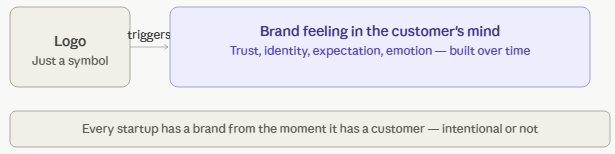
Branding is the feeling a person has about your company. It is the set of associations, expectations, and emotions that live in someone’s mind when they hear your name — before they open your app, before they read your website, before they even decide whether to try your product.
Your logo is a trigger for that feeling. It is not the feeling itself.
This distinction matters enormously for startups because it changes where you invest your attention. Founders who think branding is design spend money on agencies and aesthetics. Founders who understand what branding actually is spend time deliberately building the associations they want to own in their customer’s mind.
What branding actually is
The most useful definition of a brand comes from the advertising executive David Ogilvy, who described a brand as the intangible sum of a product’s attributes — its name, packaging, price, history, reputation, and the way it is advertised.
In simpler terms: your brand is everything a customer thinks and feels about you, whether you intended it or not.
This is important because it means every startup has a brand from the moment it has a customer. The question is not whether you have a brand — it is whether you are building it deliberately or leaving it to chance.
A startup that ships a buggy product and ignores customer complaints is building a brand. It just is not the brand they wanted. A startup that responds to every negative review within an hour is also building a brand. The experience customers have at every touchpoint is accumulating into an overall impression — and that impression is the brand.
How boAt built a brand without building a better product
boAt’s headphones are not the best headphones available at their price point. Any honest audio review will tell you that. There are technically superior options from lesser-known brands available for the same or lower price.
boAt sells more headphones in India than almost anyone else.
The reason is branding. boAt positioned itself not as a headphone company but as a lifestyle brand for young Indians who want to look like they belong to a music and sports culture. Aman Gupta wore boAt earphones on Shark Tank India — not because they sounded best but because the association between boAt and founder culture, between boAt and aspiration, was the product.
When a college student buys boAt, they are not primarily buying audio quality. They are buying a signal about who they are. That signal is the brand — and boAt built it deliberately through celebrity associations, aggressive social media presence, and positioning that had nothing to do with technical specifications.
This is what branding does that a product specification cannot. A spec sheet tells you what something does. A brand tells you what owning it says about you.
How Mamaearth built a brand around a belief
Mamaearth launched in 2016 with a specific brand positioning: toxin-free baby products made safe for Indian families.
The brand was not built around product features — it was built around a belief. The belief that most baby products in the Indian market contained harmful chemicals, and that parents deserved better. Every product, every piece of packaging, every marketing communication reinforced that belief.
By the time Mamaearth expanded beyond baby products into skincare for adults, the brand equity transferred automatically. Customers who trusted Mamaearth for their children trusted it for themselves — not because they had evaluated the formulations independently but because the brand association of “safe, natural, toxin-free” was already established in their minds.
This is what brand equity means in practice. It is the accumulated trust and association that allows a company to extend into new products or markets with less resistance than a new entrant would face. Mamaearth earned that equity not through advertising spend alone but through consistent positioning maintained over years.
As we explored when examining what a business model actually is, the most valuable businesses build things that compound. Brand equity is one of the most powerful compounding assets a company can build — and unlike a product feature, it is extremely difficult for a competitor to copy.
The three things a brand actually does
Understanding branding becomes easier when you understand what a brand is actually doing for a business.
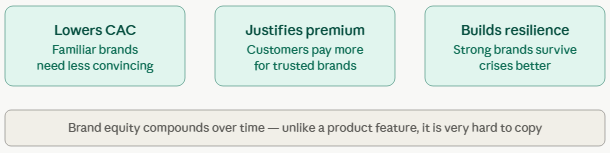
First, a brand reduces the cost of customer acquisition over time. A customer who already has a positive association with your brand requires less convincing to try a new product. Every marketing rupee spent reinforcing a strong brand works harder than the same rupee spent by an unknown company introducing itself.
Second, a brand justifies a price premium. Customers pay more for brands they trust and identify with — not because the product is necessarily better but because the brand association itself has value to them. The perceived value we discussed when looking at why people pay for convenience over products is directly shaped by brand. Two identical products at different price points will sell differently if one carries a trusted brand and one does not.
Third, a brand creates resilience during crises. Companies with strong brands survive product failures, PR controversies, and competitive attacks more easily than companies without them. The brand gives customers a reason to extend the benefit of the doubt — something an unknown company cannot rely on.
Why Zoho’s brand is a masterclass in differentiation
Zoho is one of the most interesting Indian brand stories precisely because it is so deliberately unconventional.
In a technology industry defined by Silicon Valley aesthetics — the minimalist logos, the mission statements about changing the world, the obsession with funding rounds and valuations — Zoho built a brand that is explicitly the opposite of all of that.
Zoho is headquartered in Chennai and proud of it. Its founder Sridhar Vembu has repeatedly and publicly rejected venture capital, the startup hype cycle, and the idea that a technology company needs to be based in a global hub to be world-class. Zoho has built schools in rural Tamil Nadu and writes about it. It has made its values — bootstrapped, Indian, long-term, employee-first — a central part of its public identity.
For a certain kind of customer — particularly businesses that are suspicious of Silicon Valley hype and want a reliable, founder-run alternative to American SaaS companies — Zoho’s brand is a powerful differentiator. The product is genuinely good. But the brand is what makes the choice feel right at a deeper level than a feature comparison.
What founders get wrong about branding
The most common mistake early stage founders make with branding is treating it as something to address after product-market fit.
This is backwards in a subtle but important way. Brand is not separate from product — it is built simultaneously, through every interaction a customer has with the company. The way you respond to a negative tweet, the tone of your onboarding email, the care in your error messages, the honesty in your pricing page — all of it is accumulating into a brand impression whether you are thinking about it or not.
The second mistake is confusing brand with logo. A logo is a symbol that triggers brand associations. The associations themselves come from experience, consistency, and time. A beautiful logo connected to an inconsistent experience builds nothing. A plain logo connected to consistently excellent experience builds something extremely valuable.
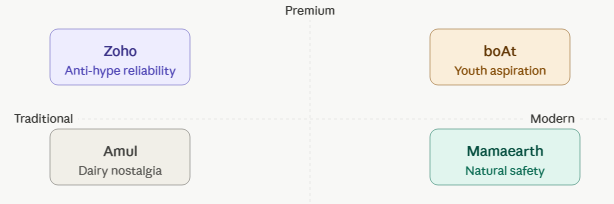
The third mistake is trying to be everything to everyone. As we will explore in the next article on positioning, the strongest brands own a specific association in a specific customer’s mind. Amul owns dairy nostalgia and Indian pride. boAt owns youthful aspiration. Mamaearth owns natural safety. None of them tried to own everything — and their clarity of positioning is what makes their brands legible and sticky.
Building your brand deliberately
For a startup founder, building brand deliberately starts with one question: what is the one thing we want to own in our customer’s mind?
Not five things. Not a mission statement with four values. One thing.
boAt’s answer was aspiration. Mamaearth’s answer was safety. Zepto’s answer was speed. Each of these is simple enough to communicate consistently across every touchpoint — and consistent communication across every touchpoint over time is how a brand is built.
Everything else — the logo, the colours, the tone of voice, the visual identity — should be in service of making that one association clearer and more consistent. They are not the brand. They are the instruments through which the brand is expressed.
Understanding business means understanding that your brand is not what you say about yourself. It is what your customers say about you when you are not in the room.
Startup takeaway:
“Your brand is not your logo. It is the feeling someone has about your company before they even open your app.”