
What Is a Target Market — and Why “Everyone” Is Not an Answer
Ask a first-time founder who their product is for and the answer is almost always a version of the same thing. Everyone. Anyone who needs this. All kinds of people. Young and old. Urban and rural. Students and professionals.
It sounds ambitious. It is actually the most expensive mistake a startup can make.
A target market is not a demographic checkbox or a vague description of humanity. It is a specific, defined group of people who share a common problem, a common context, and a common reason to care about what you are building. The narrower and more precisely you can define that group, the more powerfully you can speak to them — and the more likely they are to choose you over everyone else competing for their attention.
Why “everyone” is not a target market
When a startup tries to speak to everyone, it ends up speaking to no one in particular.
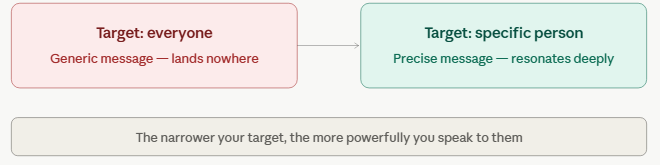
Marketing budgets get spread across channels that reach different people with different needs. Messaging becomes generic because it cannot be specific to anyone’s actual situation. Product decisions get pulled in conflicting directions because different types of users want different things. The result is a product and a brand that feels like it was made for the average person — and the average person is a fiction.
The average person does not exist. Real people have specific jobs, specific frustrations, specific aspirations, and specific reasons to care about your product. A message written for all of them simultaneously resonates deeply with none of them.
This is why branding works the way it does — the strongest brands own a specific association in a specific customer’s mind. That specificity is only possible when you know exactly who that customer is.
What a target market actually is
A target market is the specific group of people most likely to buy your product, benefit from it, and tell others about it.
It is defined by a combination of factors — who they are demographically, what situation they are in, what problem they are experiencing, and what they already believe about the world. The more precisely you can describe this person, the more useful the definition becomes.
A weak target market definition sounds like this: young Indians interested in health and fitness.
A strong target market definition sounds like this: urban working professionals between 25 and 35 in tier-1 Indian cities who go to the gym regularly, are willing to pay premium prices for quality, and are already buying protein supplements but find existing Indian brands low-quality and untrustworthy.
The second definition tells you what content to create, which influencers to partner with, what price point to set, where to advertise, and what the product needs to deliver. The first definition tells you almost nothing actionable.
How Nykaa found its target market before anyone believed it existed
When Falguni Nayar launched Nykaa in 2012, the conventional wisdom was that Indian women would not buy beauty products online. Beauty was a tactile, experiential category — women wanted to try products before buying them, and they trusted the recommendations of in-store consultants.
Nykaa bet on a specific target market that the conventional wisdom was ignoring: educated, urban Indian women between 20 and 40 who were already comfortable shopping online, who found the beauty products available at local stores limited and poorly curated, and who wanted access to international and premium brands they could not easily find elsewhere.
This was not the entire Indian beauty market. It was a specific slice of it — defined by behaviour, aspiration, and frustration, not just by age and gender.
By speaking precisely to this group — through content, curation, and a beauty education editorial strategy — Nykaa built trust with the exact customer who would become its most loyal and highest-spending user. Once that core was established, expansion to adjacent markets became much easier because the brand equity was already built.
How Paper Boat found gold in nostalgia
Paper Boat did not launch a juice brand. It launched a nostalgia brand that happened to sell drinks.
The target market was not “people who drink beverages” — it was urban Indian millennials in their late 20s and 30s who grew up drinking aam panna at their grandmother’s house, thandai at Holi, and jamun juice in the summer, and who now lived in cities where those flavours had largely disappeared.
This is an extraordinarily specific group. It is defined not just by age and location but by a shared emotional experience — the memory of flavours associated with childhood and home. Paper Boat’s entire marketing strategy, packaging design, and brand voice was built around activating that memory in that specific person.
The result was a product that people did not just buy — they shared. Because it spoke to something specific and real in a specific person’s experience, it created an emotional response that generic juice brands cannot manufacture at any marketing budget.
How Zepto defined its market with surgical precision
When Zepto launched quick commerce in India, grocery delivery already existed. BigBasket, Grofers, and others had been operating for years. Zepto did not try to win the entire grocery delivery market.
Zepto targeted a very specific customer: young urban professionals in Mumbai and Bangalore between 22 and 35, living alone or in small households, who made frequent small top-up grocery purchases rather than large weekly shops, and for whom 10-minute delivery solved a genuine daily frustration — running out of something while cooking, needing something urgently, not wanting to plan ahead.
This was not BigBasket’s customer. BigBasket targeted planned, bulk grocery shoppers who valued selection and price. Zepto targeted impulsive, convenience-driven buyers who valued speed above everything else.
By defining this customer precisely and optimising every element of the product and experience for that specific person, Zepto achieved the kind of product market fit that justified aggressive expansion. The retention numbers worked because the product was built for one specific kind of person, not for everyone.
The difference between a target market and a total addressable market
One confusion worth clearing up: your target market is not the same as your total addressable market.
Your total addressable market (TAM) is the entire universe of potential customers if you had perfect distribution and zero competition. It is a useful number for investor conversations and long-term planning.
Your target market is the specific group you are building for and speaking to right now. It is a strategic tool for decision-making, not a measure of potential scale.
A startup that confuses these two — that treats its TAM as its target market — makes the “everyone” mistake in a more sophisticated way. The number is bigger and more precise-sounding, but the problem is the same: no one in particular feels like the product was made specifically for them.
The right approach is to start narrow and expand deliberately. Dominate a specific market segment so thoroughly that you own it, then use that foundation to expand into adjacent segments where your brand and product credibility transfers.
Nykaa started with premium beauty for urban women before expanding to men’s grooming, fashion, and wellness. Zepto started in Mumbai before expanding to other metros. boAt started with budget earphones for young Indians before expanding into a full lifestyle electronics range.
In each case, the original tight target market was not a limitation — it was the foundation.
How to define your market
The most practical way to define a target market is to work through three layers.
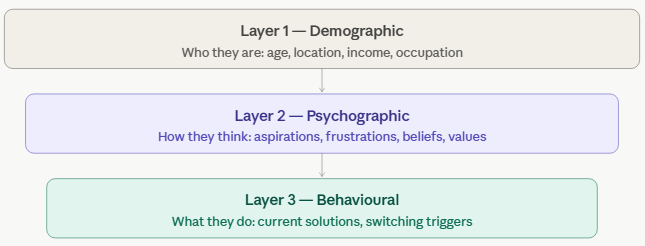
The first layer is demographic — who they are. Age, location, income, occupation, education. This is the starting point but rarely sufficient on its own. Demographics tell you who they are, not why they would care about your product.
The second layer is psychographic — how they think and what they value. What are their aspirations? What frustrates them? What do they already believe? What do they read, watch, and follow? This layer is where brand connection is built.
The third layer is behavioural — what they already do. What products do they currently use to solve the problem you are solving? What do those products fail to deliver? What would make them switch?
A target market defined across all three layers gives you a complete picture of a real person — specific enough to write one piece of content and know exactly who you are writing it for.
If you can picture that person clearly when making product, marketing, and pricing decisions, you have a target market. If you are still thinking about a broad demographic category, keep narrowing.
Understanding business means understanding that the more specifically you define who you are for, the more powerfully you speak to them.
Startup takeaway:
“The narrower your target market, the stronger your message. You cannot speak powerfully to everyone — only specifically to someone.”