Is an Online MBA Worth It — Or Can You Learn Business for Free?
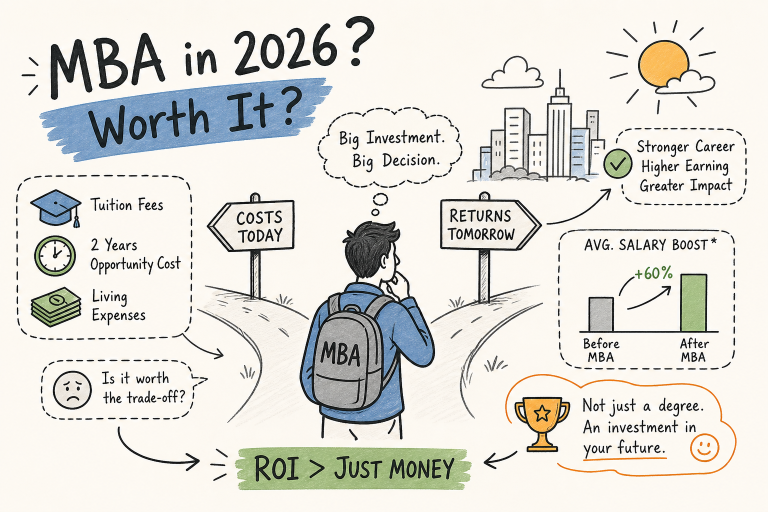
Every year, thousands of people search for online MBA programs, compare universities, calculate EMIs, and wonder whether spending two years and several lakhs of rupees on a degree is actually worth it.
It is a fair question. And the honest answer is more nuanced than most MBA program websites will tell you.
Whether an online MBA is worth it depends entirely on what you are trying to achieve — and whether a degree is the only way to achieve it.
What an online MBA actually costs
Before deciding whether something is worth it, it helps to know what it actually costs.
In India, online MBA programs range dramatically in price and credibility. IIM Bangalore’s online MBA program costs approximately ₹4-6 lakhs. ISB Hyderabad’s online programs range from ₹3 lakhs to over ₹8 lakhs depending on the specialisation. Private university online MBAs can go anywhere from ₹1 lakh to ₹15 lakhs.
Internationally, the numbers are significantly higher. The Indiana University Kelley online MBA — one of the most respected online MBA programs in the United States. It costs approximately $25,000 to $30,000 (around ₹20-25 lakhs). Arizona State’s online MBA program costs around $30,000. Wharton’s online MBA equivalent through Coursera is more affordable at around $9,000. But does not carry the same credential weight as a full degree.
On top of tuition, there is the opportunity cost — the time spent studying instead of building, working, or earning. For a founder or working professional, that hidden cost is often larger than the tuition itself.

What an MBA actually teaches you
This is where the conversation gets interesting — because the MBA curriculum is not a secret.
A standard MBA program covers a defined set of subjects across two years. Business fundamentals including accounting, finance, and economics. Marketing and consumer behaviour. Operations and supply chain management. Strategy and competitive analysis. Organisational behaviour and leadership. Entrepreneurship and innovation.
These are not proprietary frameworks locked inside university walls. They are documented, published, and in many cases available completely free through platforms like MIT OpenCourseWare, Coursera, and NPTEL.
This is precisely why CasualMBA exists. The curriculum we are building — Semester 1 covering Business Fundamentals, Semester 2 covering Marketing and Growth, Semester 3 covering Finance — maps directly to what MBA programs teach. The difference is that we explain every concept through startups and companies you already know. Without the jargon, and without the tuition fee.
The knowledge itself has never been the problem. Access and explanation have been.
Is an online MBA respected by employers?
This is the question most people are actually asking when they search “is online MBA worth it” — and the honest answer has changed significantly in the last five years.
A decade ago, online degrees carried genuine stigma. Employers were sceptical about the quality of online education and the credibility of institutions offering it.
That has shifted considerably. According to the Graduate Management Admission Council, employer acceptance of online MBA degrees has grown substantially, particularly post-pandemic. Most large employers now evaluate the institution granting the degree rather than the format in which it was delivered.
An online MBA from IIM Bangalore or Indiana University Kelley is respected. An online MBA from an unaccredited private institution is not — regardless of whether it was online or in-person.
The format matters far less than the institution. Which leads to the most important question anyone considering an online MBA should ask: is this institution genuinely accredited and recognised?
Online MBA programs without GMAT
One of the most searched terms in this space is “online MBA no GMAT” — and many programs have responded to this demand.
Several respected programs now offer admission without GMAT scores including IIM online programs, Manipal University, Amity Online, and several international programs including certain Arizona State offerings. The absence of a GMAT requirement does not automatically make a program less valuable, but it does remove one of the traditional barriers to entry.
For working professionals who have years of practical experience and do not want to spend months preparing for a standardised test, no-GMAT programs make the MBA more accessible. Whether the resulting degree carries the same weight as a GMAT-required program depends on the employer and industry.
Who an online MBA is genuinely worth it for
An online MBA makes real sense in specific situations.
If you are targeting a career in corporate management, consulting, investment banking, or a large multinational organisation — a degree from a recognised institution signals credibility in a way that self-learning currently cannot replicate. These career paths have structured hiring processes that filter by credential. The MBA is not just education in these contexts — it is a ticket.
If you are looking to switch industries or functions — moving from engineering to marketing, or from operations to finance — an MBA provides a structured credential that explains the transition to future employers.
If networking is a priority — an MBA cohort, even online, connects you with peers, alumni, and faculty in ways that self-directed learning does not. The IIM and ISB networks in India carry genuine career value.
If your employer is paying for it — the ROI calculation changes dramatically when the cost is someone else’s.
Who an online MBA is probably not worth it for
If you are building a startup, the traditional ROI argument for an MBA weakens considerably.
Startup success does not correlate strongly with MBA credentials. The founders of Flipkart, Zepto, Razorpay, and most of India’s significant startups built their companies on execution, market insight, and product thinking — not on classroom frameworks. An MBA teaches you how to analyse businesses. Building one requires a different set of skills that are mostly learned by doing.
If your goal is to understand business concepts, develop strategic thinking, or become a sharper thinker about how companies work — the curriculum is genuinely available for free. MIT, Wharton, IIM Bangalore, and Yale have all published their core course materials openly. The gap between a self-directed learner and an MBA graduate in terms of actual knowledge is far smaller than the gap in cost.
If you are early in your career and considering an MBA primarily because you are unsure what else to do — this is the most expensive form of procrastination available. The two years and the lakhs spent would almost always compound more effectively if directed toward building something, developing a specific skill, or gaining direct industry experience.
The most affordable online MBA programs
For those who have decided an online MBA makes sense but are looking for the most cost-effective accredited options, the landscape in India offers genuine value.
IIM programs through their online and distance learning divisions offer the credibility of the IIM brand at a fraction of residential program costs. IGNOU’s MBA program remains one of the most affordable accredited options in India at well under ₹1 lakh, though it carries less brand weight than IIM offerings. Symbiosis Centre for Distance Learning and Amity Online offer mid-range options between ₹1-3 lakhs with reasonable industry recognition.
Internationally, the University of the People offers an accredited online MBA at extremely low cost — primarily assessment fees — and is accredited by the Distance Education Accrediting Commission. It will not open the same doors as Kelley or Wharton, but for someone seeking a legitimate credential on a tight budget it is a serious option.
The honest verdict
An online MBA is worth it if you need the credential specifically — for corporate career progression, industry switching, or employer-sponsored development. The format is now broadly accepted. The institution matters far more than the delivery method.
An online MBA is not worth it if what you actually want is business knowledge and sharper thinking. That is available free, from the same professors, through the same frameworks — without the debt, without the two years, and without the opportunity cost.
The MBA curriculum has always been valuable. What has changed is that the knowledge inside it is no longer locked behind tuition fees.
If you are a founder, a startup enthusiast, or someone who wants to think more clearly about how businesses work — you are already in the right place.
Every concept an MBA program teaches, we cover here. Free, simple, and built around the startups you already know.
Understanding business means understanding that the knowledge was never the expensive part. The certificate was.
Startup takeaway:
“An MBA teaches you how to analyse businesses. Building one is a different course entirely — and it has no prerequisites.”