What Is Digital Marketing? A Plain-English Guide
If you’ve ever tried to explain what digital marketing is and ended up waving your hand and saying “social media and Google ads, I think,” you’re not alone. That answer isn’t wrong. But the gap between that shorthand and actually understanding how it works is costing you clarity when you need it most.
The term covers a wide spectrum of channels, tactics, and tools, which is exactly why it feels slippery. At CasualMBA, we break down how businesses actually grow, and digital marketing is one of the most misunderstood levers in that story. It’s not a single thing you do. It’s a system of channels that works differently depending on your stage, your budget, and what you’re selling. By the end of this piece, you’ll have a working digital marketing definition you can actually repeat, a clear map of the major channels, and a concrete 30-day plan to start building traction.
What digital marketing actually is (and why every business cares now)
The one-sentence definition that actually makes sense
Digital marketing is the use of digital channels and devices to promote products or services and reach customers. That’s the core digital marketing definition, and it’s simpler than most people expect. Adobe frames it as using digital channels to boost brand awareness and drive traffic. The American Marketing Association (AMA) defines it as marketing conducted through electronic devices, including the internet. Salesforce extends it to any digital platform, connected or not. The common thread: digital channels replace or supplement traditional ones like TV, print, and radio. You’ll also hear it called online marketing or internet marketing, same idea, different labels.
The real difference between digital and traditional marketing isn’t just the medium. A billboard reaches everyone who drives past it. A Google search ad reaches only the person actively searching for what you sell, at the moment they’re searching for it. That targeting precision, combined with real-time measurement, is why digital now accounts for roughly 56% of total marketing budgets, according to recent industry data. The spending follows the measurability.
Why startups default to digital from day one
A startup with a $2,000 budget can run an email campaign or publish a blog post today. Buying a TV spot or printing a magazine spread, costs that typically run into tens of thousands of dollars with months of lead time, means a single person sees the ad long before you know whether it worked. Digital marketing is the great equalizer: a solo founder can compete for attention against brands with million-dollar budgets, at least in the early innings, because the barrier to entry is low and the feedback loop is fast. (Those cost comparisons are illustrative; actual figures vary widely by market and format.)
That speed matters more than most people realize. You write an email, send it, and start seeing open-rate data within hours. You publish a blog post and watch search impressions build over the following weeks. You run a Facebook ad and have click-through rate data by the next morning. Reporting windows vary by platform and list size, but the core point holds: digital channels let you test, learn, and adjust far faster than traditional media ever allowed. That’s a genuine competitive advantage when you’re still figuring out what resonates with your audience.
The main digital marketing channels, decoded
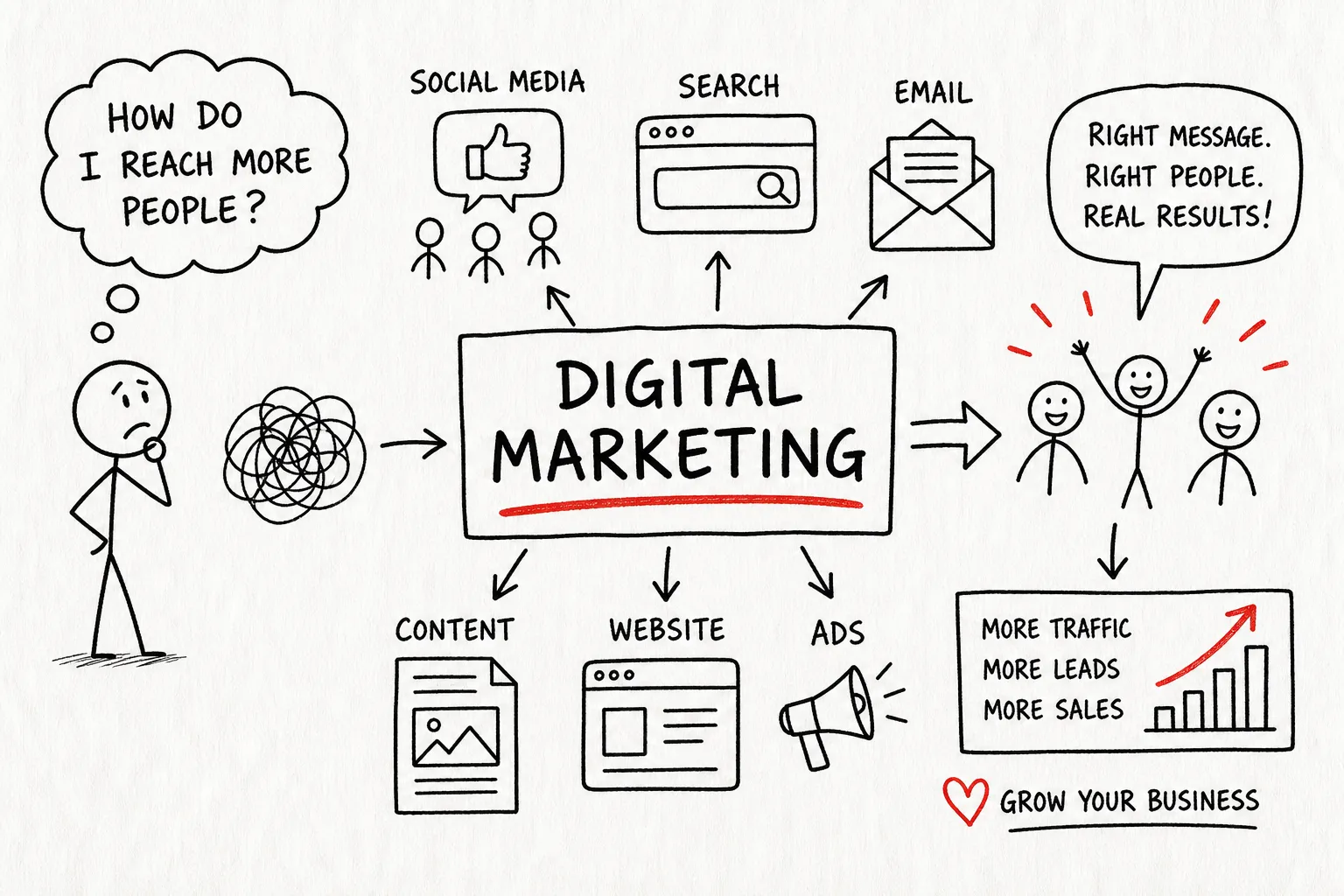
This guide focuses on the channels most relevant for startups and growing businesses: SEO, content marketing, social media, email, and paid advertising. Other channels, affiliate marketing, mobile marketing, and analytics platforms, matter too, but these five are where most businesses find their earliest traction.
Organic channels: SEO and content marketing
SEO, or search engine optimization, is the practice of making your content show up in search results without paying for placement. Content marketing is the engine that powers SEO: blog posts, guides, videos, and tools that answer the real questions your audience is already searching for. Together, they build a traffic asset that compounds over time. The longer a well-optimized post ranks, the more clicks it earns without any additional spend.
The trade-off is time. SEO takes months to produce meaningful results, which makes it a poor fit if you need customers by next Friday. But once it’s working, there’s no cost per click on organic traffic, unlike paid ads, and visitors keep arriving even when you’re not actively running campaigns. Content production and ongoing maintenance do have real costs, so “free traffic” isn’t quite accurate, but the long-term return on well-executed SEO is hard to match. For businesses playing a long game, content-driven SEO is one of the highest-return investments available.
Social media and email marketing
Social media marketing is about building an audience on platforms like TikTok, Instagram, LinkedIn, or YouTube and using that audience to generate awareness, engagement, or direct sales. The channel that makes the most sense depends entirely on where your audience actually spends time, not where you feel comfortable posting. TikTok works for consumer brands targeting younger demographics. LinkedIn works for B2B and professional services. Picking the wrong platform is a fast way to spend a lot of time for very little return.
Email marketing reaches people who already opted in to hear from you, which makes it one of the highest-converting channels available. Studies on email benchmarks consistently show email outperforming social media on ROI, the core reason being audience intent. The person who gave you their email address already raised their hand. That’s a fundamentally different relationship than someone who scrolled past your Instagram ad while half-watching Netflix.
Paid advertising: PPC and digital ads
Pay-per-click advertising means you pay every time someone clicks your ad, whether it lives on Google Search, Instagram, YouTube, or a display network. The major starting points are Google Ads for search intent and Meta Ads for interest-based and demographic targeting. Paid ads produce results faster than any organic channel, but the traffic stops the moment your budget runs out. That’s the fundamental trade-off: speed now versus compounding value later.
Paid ads work best when you already understand your numbers. If you know that a new customer is worth $200 over their lifetime and you can acquire them for $40, scaling that paid channel is a straightforward decision. If you don’t know those numbers yet, paid ads can feel like pouring money into a black hole. Run paid campaigns to gather data first, then optimize for profitability.
How real startups use these channels to grow fast
Duolingo’s TikTok playbook: social media done right
Duolingo grew its TikTok following from a few thousand to over 16 million by treating the platform like an entertainment channel, not a brand broadcast channel. The strategy: make content that feels like it belongs on TikTok rather than content that looks like an ad. The green owl mascot became a recurring internet personality, reacting to trends, making absurdist jokes, and engaging with user comments in ways that felt genuinely funny rather than corporate.
What Duolingo figured out is that TikTok rewards content that fits its culture, not content that interrupts it. The team jumped on memes quickly, leaned into self-awareness, and treated engagement as part of the content strategy. The result wasn’t just a big follower count. Duolingo connected TikTok virality directly to new app signups by asking users how they heard about the product during onboarding. Social media worked because they closed the loop between entertainment and acquisition. Coverage of Duolingo’s TikTok strategy explains how the company deliberately leaned into platform-native content to drive growth.
How Airbnb built a search engine machine
Airbnb’s SEO strategy is one of the most studied in startup history. By generating a large volume of individual location-based landing pages, “Homes in Paris,” “Cabins in the Smoky Mountains,” “Treehouses in Vermont”, they captured long-tail search traffic at a scale competitors couldn’t easily replicate. Each page matched a specific search query with a relevant, well-structured result. Google rewarded them with organic traffic that kept growing without proportional ad spend.
The lesson here is not that you need an enormous page count. It’s that SEO at its core is about matching your content to exactly what your audience is searching for, then building the internal structure that helps search engines understand and trust your site. Airbnb solved real search queries better than anyone else and built a compounding traffic asset in the process. If you’re building listings or localized pages yourself, an Airbnb SEO checklist is a practical place to start adapting these tactics to your listing strategy.
Email and paid ads working in real products
A SaaS company that gives users a free trial uses a welcome email sequence to move those users toward a paid subscription. The sequence starts with setup tips, moves to feature highlights, and ends with a “your trial ends in 3 days” prompt. That sequence converts passive trial users into paying customers by delivering value at the right moments. It’s not complicated; it’s just well-timed relevance.
On the paid side, a DTC brand running Facebook retargeting ads shows product ads to visitors who browsed the site but didn’t buy. The audience already knows the brand, so the friction is lower than with cold traffic. Retargeting ads generally outperform prospecting ads for conversion because you’re re-engaging people who already expressed interest, a much warmer starting point than reaching someone who’s never heard of you.
The numbers that tell you if it’s actually working
Top-of-funnel metrics: are people seeing and clicking?
Click-through rate (CTR) is the share of people who saw your content or ad and clicked on it. It’s calculated as clicks divided by impressions, multiplied by 100. Think of CTR as measuring how many people stopped to look at a store window, not how many walked in and bought something. A high CTR tells you your message is resonating. A low CTR tells you to test a different headline, image, or offer.
Impressions and traffic sit alongside CTR as awareness metrics. They tell you whether you’re getting eyeballs on your content. These numbers matter for understanding reach, but don’t confuse volume with performance. A million impressions with zero conversions is a branding exercise, not a growth channel. For current industry context and benchmarks, see recent digital marketing statistics for 2025.
Bottom-of-funnel metrics: are you making money?
Four numbers give you the full picture of whether a campaign is actually profitable:
- Conversion rate, the percentage of visitors who took the action you wanted
- CPA (cost per acquisition), what you paid to get one customer
- ROAS (return on ad spend), how much revenue you generated for every dollar spent on ads
- LTV/CAC ratio, lifetime customer value compared to acquisition cost, which tells you whether the math works long-term
If your CPA is $40 and your average customer LTV is $200, you have a healthy acquisition model. If your CPA is $180 and your LTV is $200, you’re technically profitable but one bad month kills the margin. These four metrics together give you a clear picture that no amount of follower counts or vanity metrics can replace.
How to start your own digital marketing in 30 days
Pick one channel and commit to it
The most common beginner mistake is trying to be everywhere at once: a blog, Instagram, TikTok, a newsletter, and Google Ads, all in the first month. The result is mediocrity across the board. Pick one channel and learn it well enough to see real data before adding another. If you have more time than money, start with SEO or organic social. If you have a small budget and need faster feedback, start with paid ads. If you already have any kind of audience, start with email.
The goal of your first 30 days is to get one real data point from one channel, something concrete, like a click-through rate on your first ad, an open rate on your first email sequence, or a ranking position for your first optimized post. That data point is what you build the next decision on.
The free tool stack for beginners
You don’t need to spend money on tools to get started. For SEO and analytics, set up Google Search Console and Google Analytics 4 first. They’re free, they’re foundational, and every other tool you add later will make more sense once you understand the data these two produce. For email, Mailchimp and Brevo both have free plans that handle small lists and basic automation. For social scheduling, Buffer’s free plan covers the basics without friction.
For paid ads, the platforms themselves are free to use. You only spend money on actual ad budget, which means you can learn the interface, build your first campaign, and set a $5/day test budget without committing to anything large. Start in the native dashboards before adding third-party reporting tools. For a practical roundup of beginner-friendly SEO apps, check this list of the best SEO tools for beginners.
A simple 30-day action plan to build momentum
- Week 1: Set up Google Analytics 4 and Google Search Console, then pick your first channel.
- Week 2: Create your first piece of content or build your first campaign, one blog post, one email sequence, or one ad set.
- Week 3: Launch it and start collecting data. Resist the urge to change everything immediately. Let it run long enough to generate meaningful signals.
- Week 4: Review the numbers and make exactly one change based on what you learned.
The iteration habit is more valuable than any single campaign result. Businesses that get good at digital marketing aren’t doing something magical. They’re measuring, adjusting, and repeating faster than their competitors.
Start here, keep building
Digital marketing is not one thing. It’s a collection of channels, and the best businesses mix them based on their stage, budget, and audience. Airbnb didn’t buy billboards to grow; they built a search engine machine. Duolingo didn’t run traditional TV spots; they became a TikTok personality. Neither approach would have worked for the other company, and that’s the real lesson: channel fit matters as much as execution quality.
At CasualMBA, we break down exactly this kind of framework every week: how real businesses grow, which levers they pull, and why those decisions make sense given their constraints. If you want real-world business breakdowns in your inbox without the jargon, subscribe and join the readers building sharper business instincts one example at a time. For a concise guide to digital marketing, that covers the basics and pathways to deeper learning, check this resource.
Now that you know what digital marketing is, pick one channel this week and see what the data tells you.