
What Is Positioning in Marketing — and How Mamaearth Beat the Giants
Hindustan Unilever has been selling personal care products in India for decades. It has distribution in every corner of the country, marketing budgets that dwarf most Indian startups, and brand recognition that most founders can only dream of.
Mamaearth launched in 2016 with none of that. No distribution network. No legacy brand. No marketing war chest.
Within a few years Mamaearth was valued at over ₹24,000 crore and had filed for an IPO.
It did not beat HUL by making better products. It beat HUL by owning a position in the customer’s mind that HUL could not take without contradicting everything its existing brands stood for.
That is what positioning actually is — and why it is one of the most powerful strategic tools available to a startup competing against established giants.
What positioning actually means
Positioning is the place your product occupies in a customer’s mind relative to the alternatives.
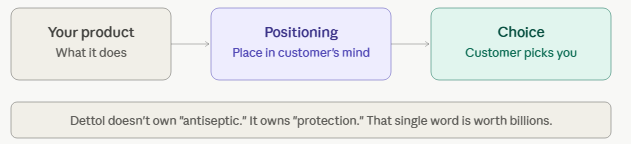
It is not a tagline. It is not a mission statement. It is not what your product does technically. It is the answer to one question in the customer’s mind: when I think of this category, where does this brand fit — and how is it different from everything else I could choose?
The concept was defined most precisely by Al Ries and Jack Trout in their foundational work on marketing strategy. Their central argument was that positioning is not something you do to a product — it is something you do to the mind of the prospect. The product itself matters, but the position it occupies in perception is what drives choice.
This matters enormously for startups because it means the goal is not to build the objectively best product. The goal is to own a specific position in a specific customer’s mind so clearly and so consistently that when they think of that need, your brand is the automatic answer.
Dettol does not make the most technically advanced antiseptic on the market. It owns the word “protection” in the Indian consumer’s mind so completely that any cut, any surface, any germ-related concern immediately triggers the Dettol association. That ownership is worth more than any product specification.
How Mamaearth found a position the giants left open
When Mamaearth entered the personal care market, HUL, P&G, and Johnson and Johnson owned the mainstream. They were competing on price, distribution, and legacy trust — the things large incumbents are best at.
What they were not competing on was natural, toxin-free formulations for health-conscious Indian consumers.
This was not because the market did not exist. It was because owning that position would require those companies to implicitly question the safety of their existing product lines — a contradiction they could not afford commercially. A company that has sold the same shampoo for thirty years cannot suddenly pivot to “toxin-free” without raising uncomfortable questions about what was in the shampoo before.
Mamaearth identified this gap and occupied it deliberately. Every product, every piece of packaging, every piece of communication reinforced the same position: safe, natural, toxin-free, made for health-conscious Indian families.
The position worked because it was credible coming from a new brand with no legacy to contradict, and because it addressed a real and growing anxiety among Indian consumers about what they were putting on their skin and their children’s skin.
As we explored when examining what branding actually is, the strongest brands own a specific association in a specific customer’s mind. Positioning is the strategic decision about which association to own — made before the branding work begins.
How Dettol owns a position permanently
Dettol is one of the most instructive positioning case studies in Indian business because it illustrates what happens when a brand owns a position completely.
Dettol owns protection. Not cleaning. Not hygiene in general. Protection — specifically from germs, infection, and harm.
This position has been reinforced consistently for decades across every product the brand has launched. Dettol soap protects. Dettol handwash protects. Dettol surface cleaner protects. The product range has expanded enormously but the position has never changed.
The result is that Dettol has become what marketers call a generic brand — a brand so dominant in its position that its name becomes synonymous with the category itself. When a parent in India wants to clean a wound, they do not think “antiseptic liquid.” They think Dettol. That mental shortcut is the ultimate expression of positioning done right.
A new competitor entering the antiseptic category does not just have to make a better product. It has to dislodge a position that has been reinforced in the Indian consumer’s mind for generations. That is nearly impossible — which is why positioning, once established, is one of the most durable competitive advantages a brand can have.
How Tanishq repositioned an entire category
Tanishq’s positioning story is different from Mamaearth and Dettol because it did not find an empty position — it actively repositioned an existing category.
Gold jewellery in India had always been positioned around investment and tradition. You bought gold because it held value, because it was auspicious, because it was expected at weddings and festivals. The purchase was rational and cultural — not particularly emotional or personal.
Tanishq repositioned gold jewellery as a celebration of the modern Indian woman’s identity and milestones. Not investment. Not tradition. Emotion, self-expression, and the marking of personal moments.
This repositioning opened an entirely new conversation with a customer — urban, educated, working Indian women — who had not previously seen jewellery as something for themselves in a personal sense. It created a new reason to buy that did not depend on auspicious occasions or investment logic.
The repositioning required consistent execution across product design, advertising, store experience, and communication over many years. Tanishq’s campaigns — many of which depicted progressive social themes that its competitors would not have touched — were not just advertising. They were positioning statements about what the brand stood for and who it was for.
Zepto versus BigBasket — positioning within the same category
Positioning does not only happen between a startup and legacy giants. It happens between startups competing in the same space.
When Zepto entered the grocery delivery market, BigBasket was the established player. A head-on attack on BigBasket’s position — wide selection, trusted quality, reliable delivery — would have been very difficult to win. BigBasket had years of operational infrastructure and brand trust that Zepto could not replicate quickly.
Zepto chose a different position entirely. Not better grocery delivery. Faster grocery delivery — specifically ten minutes, specifically for top-up purchases, specifically for the urban professional who had run out of something and needed it now.
This position was not competing with BigBasket for the same customer doing the same thing. It was defining a different customer doing a different thing in the same broad category. As we discussed when examining what a target market actually is, Zepto’s precision in defining its customer made its positioning possible — you cannot own a specific position if you do not know specifically who you are positioning for.
The result is that BigBasket and Zepto can coexist in the same market because they occupy genuinely different positions in the customer’s mind. BigBasket is where you do your weekly shop. Zepto is what you open when you realise you are out of milk while cooking dinner.
The three questions that define your positioning
Positioning is ultimately the answer to three questions asked from the customer’s perspective.
The first question is who is this for. Not broadly — specifically. The answer should describe a real person in a real situation with a real problem, not a demographic category.
The second question is what category does this belong to. This is the frame of reference — the competitive set the customer uses to evaluate options. Zepto positioned itself in “immediate grocery needs” not “grocery delivery.” Mamaearth positioned itself in “safe personal care” not “personal care.” The category you choose to compete in shapes everything about how customers evaluate you.
The third question is why this and not something else. This is the point of difference — the specific reason a customer in this situation should choose you over every alternative. It should be specific enough to exclude most competitors and true enough to survive contact with the actual product experience.
A positioning that cannot answer all three questions clearly is not positioning — it is a vague aspiration that will not drive consistent decisions across product, marketing, and communication.
What Is Positioning in Marketing
What startups get wrong about positioning
The most common mistake is confusing positioning with differentiation. Differentiation is having something different. Positioning is owning a specific place in the customer’s mind based on that difference.
A product can have a hundred differentiating features and still have no clear position because none of those features adds up to a single, clear, ownable answer to the question “what is this for and why should I choose it.”
The second mistake is trying to own too many positions simultaneously. A brand that claims to be the fastest, safest, most affordable, and most innovative occupies no position at all — because those claims cancel each other out and leave no single, memorable association in the customer’s mind.
The third mistake is positioning for investors rather than customers. A pitch deck positioning of “the AI-powered, full-stack, end-to-end solution for the modern enterprise” is not a position. It is a collection of buzzwords designed to signal ambition to a funding audience. Real positioning is what a real customer thinks when they encounter your product in the real world.
Mamaearth did not become India’s fastest-growing personal care brand by having the best pitch deck. It became that by owning one clear position — safe, natural, toxin-free — and defending it consistently across every customer touchpoint for years.
Understanding business means understanding that the battle for customers is won in the mind, not on the shelf.
Startup takeaway:
“Positioning is not what your product does. It is what your product means — to a specific person, in a specific situation, compared to everything else they could choose.”