
Why Do Businesses Exist in the First Place?
Most people think businesses exist to make money. Technically, that’s true. But it’s also incomplete.
Money is usually the result of a business working well, not the fundamental reason it exists. If making money alone was enough, every new startup would survive. Most don’t.
To understand why businesses actually exist, it helps to look at something much simpler: human behavior.
Businesses exist because humans constantly look for easier, faster, safer, or better ways to live. Every successful company is built around solving some form of friction in people’s lives.
Businesses Are Organized Solutions to Problems
At the most basic level, businesses exist to solve problems at scale.
A local tea stall exists because commuters want tea quickly before work. A delivery app exists because people are too tired to cook after a long day. Streaming platforms became popular because people hated waiting for television schedules.
Every business starts with some version of the same idea:
“People want this process to become easier.”
The bigger the inconvenience, the bigger the opportunity usually becomes.
That’s why convenience has become one of the strongest forces in modern business. People consistently choose solutions that save:
- time
- effort
- confusion
- uncertainty
Even if they cost more.
People Rarely Buy Just the Product
This is where business becomes more psychological than technical.
Most people don’t buy products purely for utility. They buy what the product represents emotionally.
A luxury watch does not simply tell time. It signals status.
Expensive coffee is often less about taste and more about experience.
Fitness brands don’t just sell clothes. They sell identity and aspiration.
This is why branding matters so much. Businesses are not only competing on product quality anymore. They are competing on perception, emotion, and attention.
The companies that understand human psychology deeply usually outperform the ones that only focus on features.
The Internet Changed What Businesses Solve
Traditional businesses mainly solved physical problems:
- transportation
- food
- manufacturing
- communication
Modern internet businesses solve very different problems:
- boredom
- attention
- loneliness
- visibility
- identity
- entertainment
Social media platforms are a good example of this shift.
People often assume apps compete based on technology. In reality, most platforms compete for attention. The longer they can keep users engaged, the more valuable they become.
That’s why some of the biggest companies on the internet offer “free” products. Your attention itself became part of the business model.
Once businesses realized attention could be monetized, the entire internet economy changed.
Every Successful Business Removes Friction
There’s a pattern behind almost every successful modern company.
Ride-sharing apps reduce the effort of finding transportation. Food delivery apps reduce the effort of cooking.
Streaming services reduce the effort of searching for entertainment.
AI tools reduce the effort of thinking, writing, designing, or coding. Good businesses simplify life somewhere.
And the more invisible that effort becomes, the more valuable the experience often feels to users.
This is why simplicity is underrated in business. People naturally move toward systems that feel smoother and easier to use.
Businesses Also Create Trust
One of the most overlooked functions of businesses is trust.
Imagine buying medicine from a random stranger online. Now compare that to buying it from a recognized pharmacy brand. The product may be similar, but trust completely changes the decision.
That’s why branding, reviews, websites, packaging, and reputation matter so much.
Strong businesses reduce uncertainty. They create familiarity.
In many ways, brands act like trust shortcuts for the human brain. People prefer systems they recognize because familiarity feels safer.
Not All Businesses Create Value the Same Way
Some businesses genuinely improve people’s lives. Others simply become very effective at exploiting attention and emotion.
Fast food companies understand cravings.
Social media companies understand dopamine loops.
Luxury brands understand insecurity and aspiration.
Subscription apps understand habit formation.
Business itself is neutral. It’s ultimately a system built around understanding human behavior and incentives.
That’s why studying business is often less about finance spreadsheets and more about understanding how people think, behave, react, and decide.
Modern Businesses Are Becoming Ecosystems
The idea of a business is also changing.
A company today is no longer just:
- an office
- a product
- a service
Modern businesses often combine:
- content
- audience
- media
- software
- creators
- communities
- AI
- digital products
Some creators now operate like full-scale media businesses. Some startups behave more like entertainment companies. The lines between media, technology, branding, and business are becoming increasingly blurred.
The internet changed business from simply “selling products” into building systems of attention and trust.
So Why Do Businesses Exist?
Businesses exist because human beings constantly search for:
- convenience
- better experiences
- emotional connection
- certainty
- identity
- speed
- trust
Companies are simply organized systems built around fulfilling those needs.
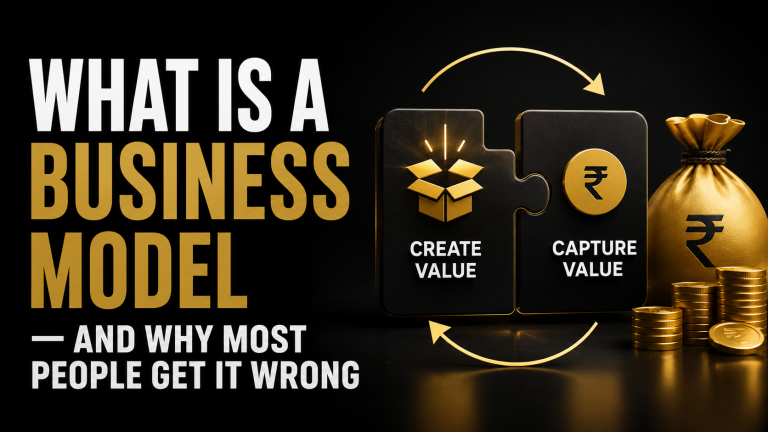
Money follows when enough people believe the solution is valuable.
That’s why the best businesses are rarely the ones with the most complicated ideas. They are usually the ones that understand people the best.
And honestly, that’s what makes business interesting in the first place.
Ready to test your understanding? Download the free Semester 1 Worksheet and apply every concept to a startup you know.